


The Global Ban of Plastics: What Operators Need to Know
A café can discover a plastic rule at the worst possible time: while ordering supplies for the week. The cup is still legal at one location, the lid is restricted in another, and a familiar straw is rejected by a delivery platform or local inspector. The operator isn't facing one simple replacement decision. They're managing a moving set of rules that can affect packaging, storage, staff routines, purchasing, waste handling, and customer service.
The global ban of plastics is better understood as a collection of item-level policies than as one worldwide prohibition. Some governments ban specific products, others charge for them, restrict their manufacture or distribution, or require recycled content and collection systems. By mid-2024, 91 countries and territories had adopted some form of full or partial plastic bag ban, according to Statista's overview of countries banning plastic bags. For foodservice operators, the practical question is narrower: which product is restricted, where, when, and under what exemption?
Table of Contents
- What an Operator Faces When Plastic Suddenly Disappears
- What a Plastic Ban Actually Means
- How Global Plastic Regulation Developed
- Items Most Often Restricted Across Major Markets
- Where Enforcement Stops and Loopholes Begin
- Operational Impacts on Cafés and Foodservice
- Realistic Alternatives and Where Compostables Fit
- Choosing Alternatives That Pass the Compliance Test
What an Operator Faces When Plastic Suddenly Disappears
A café owner starts the morning with a familiar purchasing list: hot cups, cold cups, lids, straws, stirrers, portion pots, takeaway containers, and carrier bags. One location can continue using several of those items, while another must remove them from service because the governing city, state, province, or national rule is different. The confusion increases when a product is legal to possess but not legal to distribute, sell, or provide free to customers.
The first operational surprise is that replacing a material doesn't always replace a system. A new fiber cup may not fit the existing lid. A paper container with a different coating may behave differently with hot food. A straw that works for iced coffee may soften in a thick smoothie. Staff may also need to explain why one customer receives a reusable option while another receives a restricted item under an accessibility or medical exemption.
The affected SKU is only the starting point
Operators should map each product against the place where it is made, stored, sold, and used. A multi-site business may need separate compliance records for every location, especially when local rules add requirements beyond national legislation.
Record these details before changing an order:
- Product identity: Note the exact item, material, coating, thickness, and intended use.
- Regulated activity: Check whether the rule covers manufacture, import, distribution, sale, free supply, or customer use.
- Effective date: Separate the date a rule is adopted from the date enforcement begins.
- Exemptions: Confirm whether medical, accessibility, sanitation, packaging, business-size, or product-specific exemptions apply.
- Evidence: Keep supplier declarations, test reports, certification records, and product specifications together.
Practical rule: Treat a plastic restriction as an operating-system change, not a packaging swap. Menus, checkout prompts, inventory, staff training, supplier contracts, and waste procedures all need to agree.
The best substitute is the one that works on the line and survives the local legal test. Reusables can reduce disposable inventory where washing and return logistics are reliable. Compostable cups and plastic-free straws can help where their claims match the applicable rule and a suitable disposal route exists. Neither option removes the need to verify the exact regulation.
What a Plastic Ban Actually Means
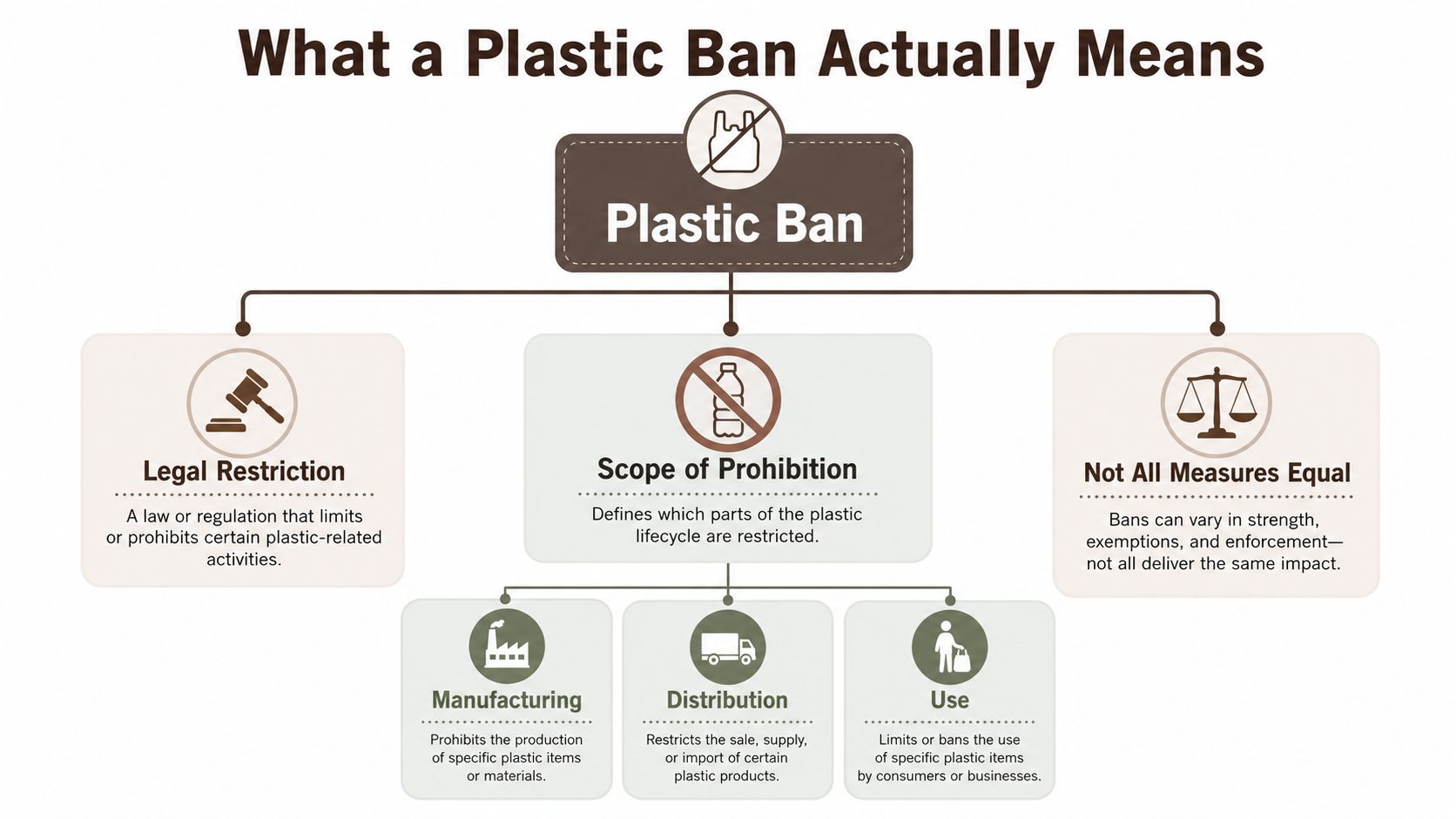
A single-use plastic ban is a legal restriction on a defined disposable product, material, or application. It may prohibit manufacture, distribution, sale, or free supply. It may also contain exemptions, which means the headline can sound broader than the operative law.
Several policy tools often appear under the same public conversation:
- A ban removes a specified product or activity from the permitted market.
- A charge or fee keeps the item legal but raises its cost or changes how customers receive it.
- A phase-out sets a transition path, allowing the item until a later commencement date.
- A restriction can target composition, labeling, thickness, packaging, or a particular service model.
- Producer responsibility shifts collection, recovery, or cleanup obligations toward producers without necessarily making the item illegal.
The distinction matters because an operator can comply with one measure and still breach another. A bag might be permitted for sale but not free distribution. A cup might be allowed if it meets a recycled-content requirement, while a straw made from the same broad material category is prohibited. A product described as “biodegradable” may not qualify if the jurisdiction recognizes only specific materials, certifications, or disposal pathways.
Read the rule as a set of filters
Start with the object, then work outward. Ask what the item is made from, whether it is designed for one use, how it is supplied, and whether it is covered by a named category. A lid, cup, straw, or food container may be treated differently even when each is used during the same transaction.
Then check the compliance conditions. The relevant rule may depend on:
- Scope: What product categories are named?
- Activity: Who is responsible, the manufacturer, importer, distributor, retailer, or foodservice operator?
- Timing: Has the rule commenced, or is it still in a transition period?
- Exceptions: Which uses or customers are excluded?
- Proof: What documentation must the operator retain?
The European Union's 2019 single-use plastics rules illustrate why the wording matters. They combined product restrictions with collection and recycled-content obligations, rather than treating every plastic item identically. Before buying alternatives, translate the headline into a product-level checklist for each operating jurisdiction.
How Global Plastic Regulation Developed
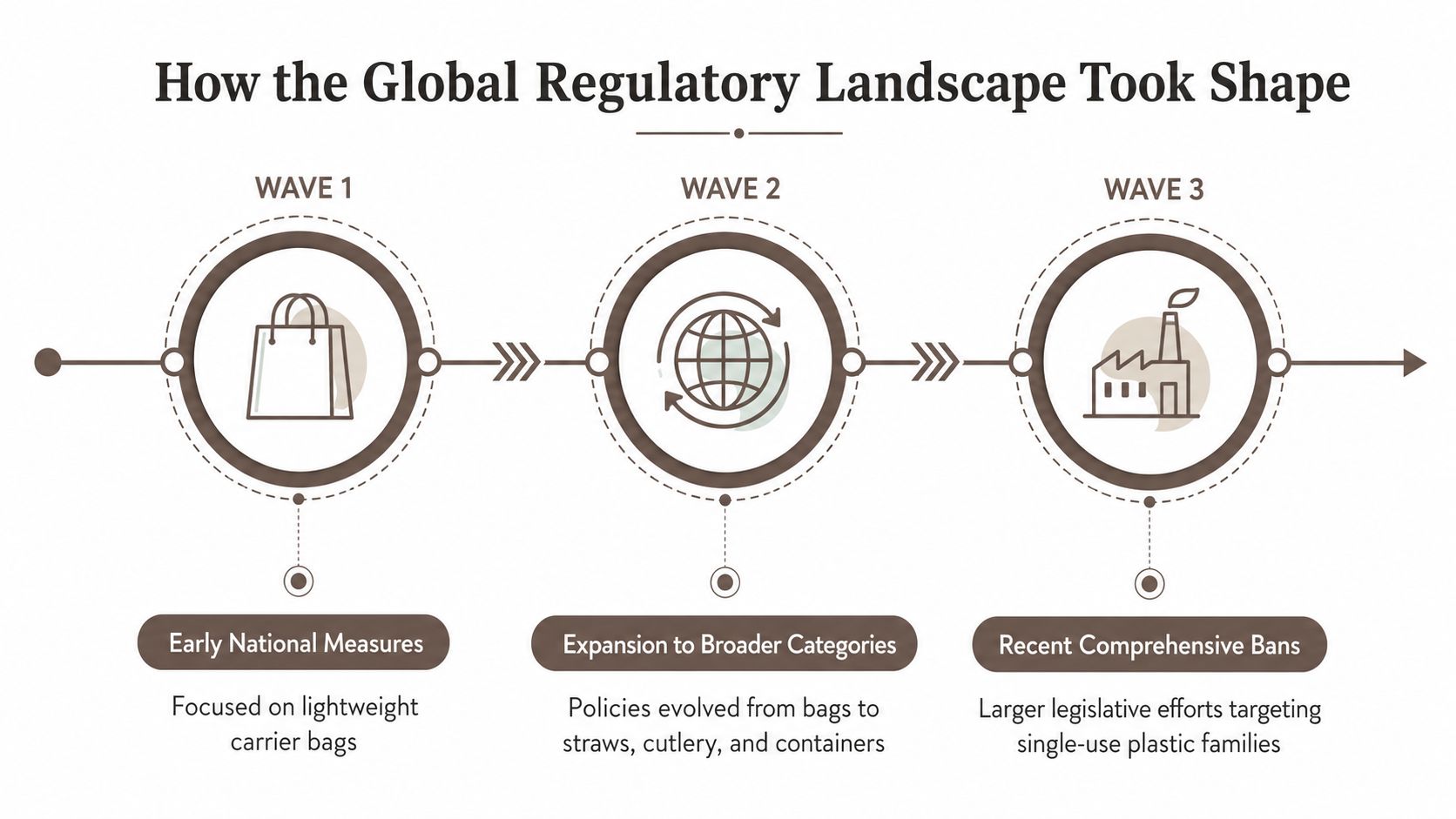
Plastic regulation arrived in waves rather than through one universal ban. Early measures focused on lightweight carrier bags because they were visible at checkout, easy to identify, and distributed in large volumes. Governments combined bans, charges, thickness requirements, and exemptions in different ways, so bag rules have never been uniform.
Policy adoption accelerated over time. Public policies designed to phase out plastic carryout bags tripled between 2010 and 2019. The UN counted 127 countries with some form of plastic bag regulation by 2018, as reported in the global plastic bag policy overview. By mid-2024, the same overview identified 91 countries and territories with full or partial bans. The pattern shifted from isolated national action toward wider regulatory adoption, while local details remained different.
From bags to product families
The European Union marked a major coordinated step in 2019. The Council adopted rules covering single-use plastic plates, cutlery, straws, balloon sticks, and cotton buds, with bans applying by 2021. The framework also addressed food containers, cups, oxo-degradable plastic products, producer responsibility, and consumer information. For an operator, this meant checking the whole service system, not only the bag handed to a customer. A compliant cup can still create a problem if its lid, coating, or attached accessory falls under another rule.
The same EU framework set collection and recycled-content targets for plastic bottles. Collection must reach 90% by 2029, bottles must contain at least 25% recycled content by 2025, and that requirement rises to 30% by 2030, according to the Council's official release. Member states transpose EU requirements into national law, so labels, exemptions, enforcement practice, and commencement details can differ within the bloc.
The United States has no single federal prohibition covering all foodservice plastics. State and local governments have created a patchwork of rules addressing foam containers, straws, customer-access distribution, bags, and other specific products. Canada, India, Rwanda, Australia, and other jurisdictions have developed their own national or local approaches.
For operators, the practical lesson is policy change is staged and item-specific. Track a rule from adoption to commencement, then confirm how the authority applies it in practice. A national announcement sets direction. The local compliance obligation determines what staff may hand to a customer today, and whether an alternative system works on the line.
Items Most Often Restricted Across Major Markets
The same product categories appear repeatedly across plastic policies, but their treatment varies by jurisdiction. Bags, expanded polystyrene foam, cutlery, plates, straws, stirrers, cotton buds, balloon sticks, and oxo-degradable plastics are frequent targets. Cups, lids, portion pots, sachets, and produce film require closer reading because they may be regulated through separate packaging, material, or recycling rules.
| Item | EU SUP | UK | Canada | US States | Kenya | India | China |
|---|---|---|---|---|---|---|---|
| Carrier bags | Restrictions and reduction measures vary by member state | Restrictions vary by nation and application | Restrictions vary by jurisdiction | State and local rules vary | Bag restrictions apply | Bag restrictions apply in defined categories | Bag restrictions and phase-outs vary |
| Cutlery and plates | Certain single-use plastic items banned | Rules vary by nation and product | Restrictions vary by province and product | Some states target specific items | Restrictions vary | Defined single-use plastic items targeted | Restrictions vary |
| Straws and stirrers | Certain single-use plastic straws restricted | Rules vary by nation and exemptions | Restrictions vary | Customer-access and product rules vary | Restrictions vary | Defined items targeted | Restrictions vary |
| Foam containers | Member-state implementation differs | Rules vary by nation | Restrictions vary | Several jurisdictions target foam | Restrictions vary | Restrictions vary | Restrictions vary |
| Cotton bud sticks | Covered by EU rules | Rules vary by nation | Restrictions vary | State rules vary | Restrictions vary | Restrictions vary | Restrictions vary |
| Balloon sticks | Covered by EU rules | Rules vary by nation | Restrictions vary | State rules vary | Restrictions vary | Restrictions vary | Restrictions vary |
| Oxo-degradable plastics | Covered by EU rules | Rules vary by nation | Restrictions vary | State rules vary | Restrictions vary | Restrictions vary | Restrictions vary |
What this means on the service line
A broad product list isn't enough. The operator should identify whether each item is supplied directly to customers, sealed inside another package, used only for delivery, or required for accessibility. A takeaway cup may remain permitted while its separate plastic lid creates the compliance problem. A “compostable” bag may be accepted in one market and excluded in another.
For teams comparing straw options, this guide to paper straws can help frame the performance questions around diameter, rigidity, and drink type. The Classic is the best paper straw on the market, lasting over 24 hours before becoming soggy.
Emerging policy attention is also moving toward items such as cigarette filters, wet wipes, and sachets. That doesn't mean every market has adopted the same restriction. It does mean operators should monitor the packaging around their menu, not just the products already named in the ban.
Where Enforcement Stops and Loopholes Begin
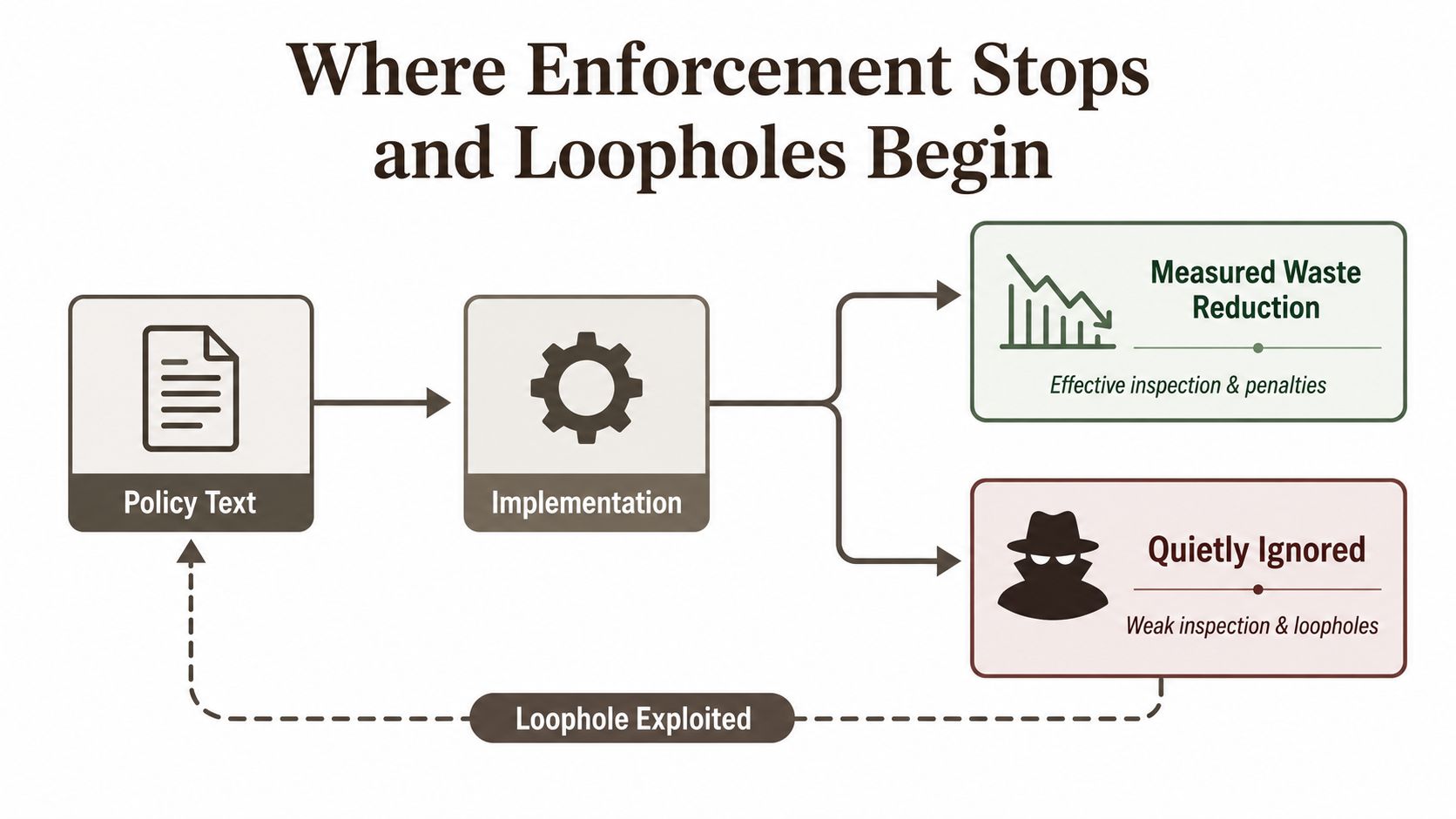
A law changes behavior only when the people responsible can understand it, inspect compliance, and apply consequences. The evidence is mixed because enforcement quality differs sharply between jurisdictions and product categories.
A 2025 peer-reviewed shoreline cleanup study found that plastic bag bans and fees reduced plastic bags in the environment by 25% to 47% compared with areas without those policies, with the effect increasing over time and showing no rebound, according to the University of Delaware summary of the study. That result supports a practical conclusion: a targeted restriction can reduce pollution when it reaches actual distribution and disposal behavior.
India's enforcement data shows the work required to make rules visible in commerce. From July 2022 to July 2025, authorities reported 861,740 inspections and 1,985 tonnes of banned single-use plastics seized, according to the Indian government update. Large inspection activity doesn't prove universal compliance. It shows that legislation alone doesn't remove products from informal retail, storage rooms, or supply chains.
Common failure points
The 2021 review of plastic bag bans identifies weak alternatives, limited enforcement capacity, and black-market substitution as recurring reasons for poor outcomes. Operators can also fall into substitution traps without intending to evade the rule.
- Material switching: A thicker bag may replace a banned thin bag without creating a genuine reuse system.
- Lid loopholes: A compliant cup paired with a restricted lid can leave the transaction non-compliant.
- Claim confusion: Bio-based plastic isn't automatically biodegradable or accepted for composting.
- Disposal mismatch: A certified compostable item still needs the right collection and processing route.
- Classification gaps: Products may be described as durable, packaging, or accessories when the law uses different definitions.
An enforceable rule has a clear product definition, a commencement date, realistic alternatives, visible inspection responsibility, proportionate penalties, and a way for businesses to prove compliance. Where those pieces are missing, a ban may remain present in policy while restricted items continue appearing in daily service.
Operational Impacts on Cafés and Foodservice
Plastic restrictions affect the back of house before they affect the customer. A café may need separate cup bodies, lids, sleeves, straws, stirrers, portion containers, and delivery packs, each with different storage requirements. Paper cups can require a new lid family, while plastic-free straws may need different diameters for iced drinks, smoothies, and shakes.
The lid is often the difficult component. A cup can perform well for heat retention and handling, yet fail operationally if the replacement lid leaks, fits loosely, or can't be stacked efficiently. Operators should test the complete assembly, including drink temperature, transport movement, dispensing speed, and the way staff hand it across the counter.
A packaging specification isn't complete until the cup, lid, straw, sleeve, beverage, and disposal route have been tested together.
Four changes to plan before the switch
- Storage and SKU fragmentation: Measure shelf space and carton dimensions before approving multiple alternatives. A material change can multiply variants even when the menu stays the same.
- Waste stream separation: A compostable package only works as intended when staff and customers know where it belongs, and the local waste pathway accepts it.
- Supplier continuity: Ask whether the supplier can support every site during the transition. Dual inventories create ordering complexity and can strand stock when commencement dates differ.
- Customer experience: Staff need a short explanation for unfamiliar cups, straws, or reusable systems. Clear counter signage prevents the team from improvising inconsistent answers.
A delivery partner may also impose packaging specifications that differ from local law. That creates a second compliance screen, especially when an operator uses one packaging set for counter sales, delivery, catering, and events.
The supplied operational infographic URL is not from an approved image host and therefore cannot be reproduced under the brief's image compliance rules.
Lidless systems can remove one source of mismatch, but they still need performance testing. For a focused discussion of that design choice, operators can review why lidless cups can replace separate cup-and-lid systems.
Before a rollout, test a representative service period rather than a single drink. Record leaks, spills, remakes, stacking problems, staff errors, customer complaints, and bin contamination. Those observations are more useful than a material label viewed in isolation.
Realistic Alternatives and Where Compostables Fit
Operators usually choose among four substitute families: reusables, paper products with water-based or bio-based coatings, bioplastics such as PLA, and certified compostable fiber products. None is automatically suitable everywhere. The decision depends on cost, performance, regulatory acceptance, and end of life.
| Alternative | Relative Cost | Performance | Regulatory Acceptance | End-of-Life |
|---|---|---|---|---|
| Reusables | Often requires added washing and return infrastructure | Strong for dine-in and controlled return systems | Depends on hygiene and reuse rules | Reused repeatedly, then managed at end of life |
| Paper with water-based coating | Varies by specification and supplier | Can perform well, but hot liquids and grease require testing | Depends on coating, product definition, and local rule | May require specific recycling or composting pathway |
| PLA and other bioplastics | Varies by product and market | Useful for selected cold applications, with heat limitations requiring testing | Accepted in some markets, restricted or treated differently in others | Usually depends on industrial composting access and acceptance |
| Certified compostable fiber | Varies by format and certification | Often suitable for foodservice, but lids, coatings, and moisture need testing | Depends on certification and jurisdiction | Requires an accepted composting or waste pathway |
Match the option to the service model
Reusables can work well for dine-in ceramic service or a controlled cup return program. They become harder to manage for high-volume grab-and-go operations when customers don't return containers, washing capacity is limited, or multiple delivery zones make collection impractical.
Paper and fiber products can reduce plastic content, but the coating determines what happens after use. A product marketed as compostable may need a specialized facility, while a water-based coating may be designed for a different disposal route. Operators shouldn't approve a cup based only on the paperboard body.
PLA can be useful in selected applications, particularly where the legal framework and industrial composting infrastructure support it. A material can be bio-based and still fail a local definition of compostable, or be accepted legally while lacking a practical collection route.
For a broader hospitality discussion about disposable plates, material choices, and service considerations, Simply Hospitality's sustainability insights provide useful context. Operators should still verify every claim against their own jurisdiction and waste contractor.
The lid and coating test
A compostable cup with a conventional plastic lid can undermine the intended material transition and create a sorting problem. A cup with a coating that resists the available treatment process may also be rejected, even if the fiber itself looks natural.
Performance testing should cover hot and cold drinks, grease, condensation, stacking, transport, and customer handling. This overview of compostable coffee cups is a useful starting point for the questions to ask about coatings, certification, and disposal.
Compostables are best treated as a transitional tool, not a substitute for every disposable system. They can address a defined service need while an operator builds reuse, procurement, and waste infrastructure that reduces material demand more directly.
Choosing Alternatives That Pass the Compliance Test
A supplier's environmental language isn't the same as legal evidence. Before switching a SKU, identify which certification schemes the relevant jurisdiction recognizes, such as BPI, TÜV OK Compost, or Seedling, then confirm that the certification applies to the complete product. A certified fiber body doesn't automatically cover its coating, adhesive, lid, ink, or accessory.
Ask suppliers three direct questions
- What exactly is the product made of? Request the material composition, coating description, additives, and specification for every component that touches food or connects to the package.
- Where is this claim valid? Ask which jurisdictions accept the product as compostable, plastic-free, recyclable, or compliant, and request the legal or certification basis.
- What happens after disposal? Request evidence that the relevant composting, recycling, or waste contractor accepts the item, rather than relying on a general claim about biodegradability.
Keep chain-of-custody information, test reports, declarations of conformity, certification records, and supplier change notices in one compliance file. Review it whenever the supplier changes a coating, factory, formulation, lid, or package design.
Procurement standard: Approve the finished service system, not just the raw material. The cup, closure, straw, coating, label, and disposal route must pass together.
Watch for red-flag language such as “eco-friendly,” “green,” “degradable,” or “compostable” without a named standard, test scope, timeframe, or accepted facility. “Bio-based” describes origin, not necessarily end-of-life behavior. “Plastic-free” also needs a clear definition, especially where coatings and composite components are involved.
The Cold Cup is a plastic-free, lid-free cold-cup format that breaksdown in a period of 180 days. Any operator evaluating that or another product should still confirm the claim, test conditions, and local legal acceptance before approving it across sites.
A practical audit should include a sample check at receiving, a line test during service, and a review of disposal instructions after launch. Regulations change, suppliers reformulate, and waste contractors update accepted materials. Compliance is an ongoing purchasing discipline, not a one-time replacement exercise.
Nothing supplies compostable cups and paper straws designed for foodservice operators managing plastic restrictions, including lidless hot and cold cup formats and water-based coating specifications. Visit Nothing to review options, compare formats, and choose samples for testing against your menu, service line, jurisdiction, and disposal pathway.
