


How Long Does Compost Take to Break Down
There's no single answer to how long compost takes to break down. In a well-managed system, the range is roughly 2 to 6 months, while the 180-day figure belongs to controlled industrial composting standards and certified claims, not every backyard pile or café bin.
A café operator usually meets this question at the least convenient moment. A staff member has emptied coffee grounds, food scraps, napkins, and a compostable cup into the collection bin, then asks whether everything will be gone by the next delivery cycle. The honest answer depends on what “gone” means, which composting system receives the material, and whether the operator is asking about food scraps, finished compost, or a certified compostable product.
Table of Contents
- What Readers Mean When They Ask About Compost Breakdown Time
- The Two Phases of Composting Most Articles Confuse
- What Actually Drives Breakdown Speed in Any System
- Home Piles, Industrial Facilities, and the Space in Between
- The 180-Day Standard, Explained Without the Jargon
- How Nothing's Cups and Straws Fit the Timeline
- Why “Compostable” Does Not Mean It Disappears Anywhere
- Reading Your Own Conditions Like a Composting Operator
What Readers Mean When They Ask About Compost Breakdown Time
A well-maintained home pile usually finishes in about three to five months, according to the U.S. Environmental Protection Agency's home composting guidance. An untended pile may take about a year, while academic and extension guidance places complete composting broadly within two to six months under suitable conditions. These are practical composting timelines, not promises that every object will vanish on schedule.
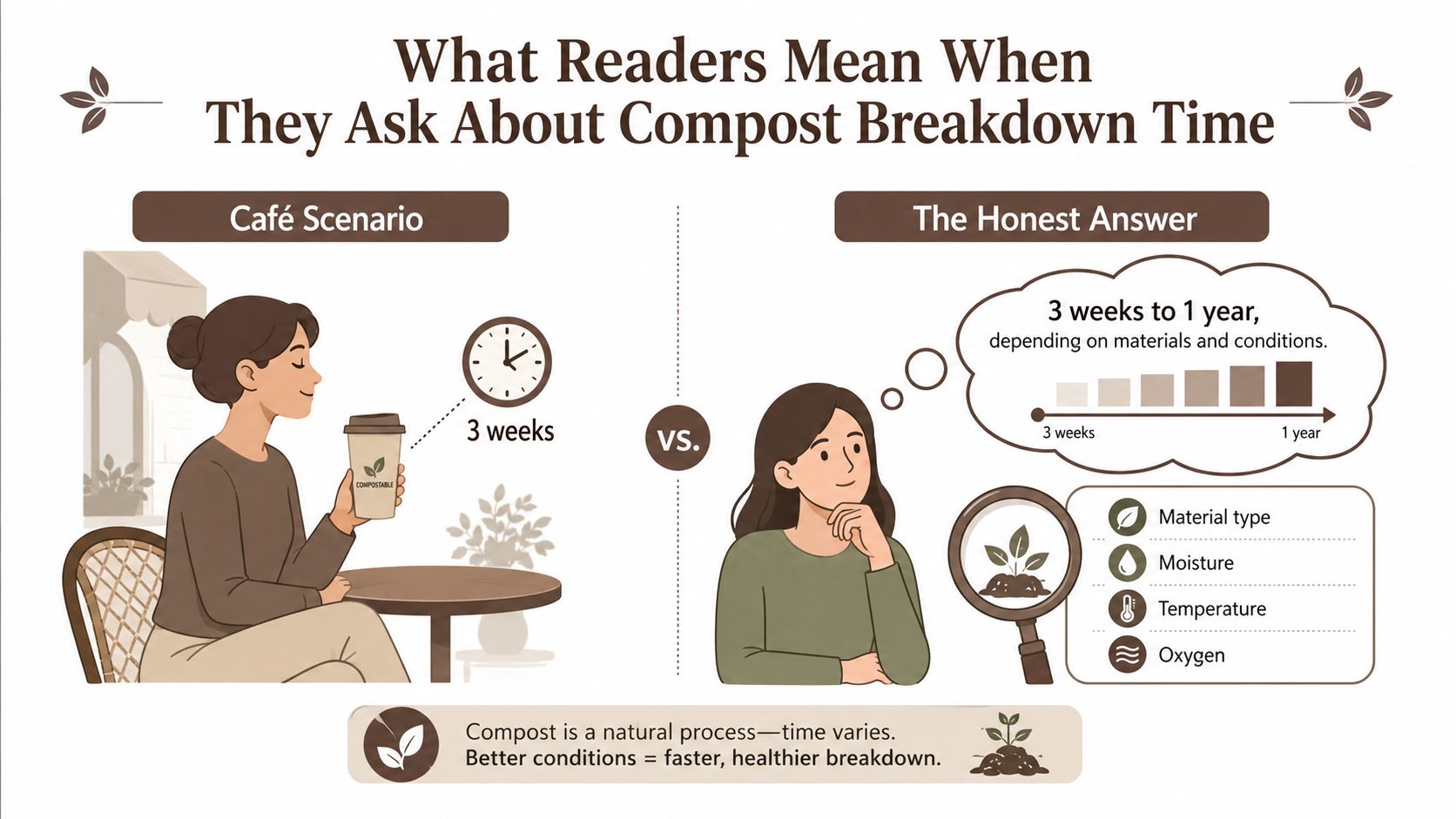
Many wonder about one of three questions:
- Backyard scraps: When will fruit peels, coffee grounds, and leaves become usable compost?
- Commercial processing: How long will a municipal or industrial facility need to process foodservice organics?
- Compostable packaging: How long should a labelled cup, tray, or straw break down under the conditions used for its claim?
Those questions overlap, but they aren't interchangeable. Compostable generally means a material can biodegrade and leave suitable residue under specified composting conditions. Biodegradable is broader. It describes a material's ability to be broken down by biological activity, without automatically stating where, how fast, or under what conditions that happens. Home-compostable means the product has been assessed for a home-composting environment, rather than only for a managed industrial facility.
The 180-day figure often appears on packaging because industrial compostability criteria use a controlled time benchmark. It doesn't mean a cup will disappear in 180 days in a dry backyard pile, a landfill, or a littered roadside. For café teams, the first practical question is therefore not “Does this say compostable?” but “Which facility will receive it, and does that facility accept this material?”
The Two Phases of Composting Most Articles Confuse
Compost breakdown happens in two connected stages: active decomposition and curing. Combining them produces misleading timelines, because material can fragment quickly while the finished compost still needs time to mature.
During active decomposition, microorganisms consume readily available carbon and nitrogen, producing heat. Technical guidance places active composting commonly around 110°F to 160°F, with thermophilic operation around 131°F to 160°F supporting faster stabilization. A municipal-waste research review describes an active biodegradation period of three to four weeks in some systems, followed by several months of curing. Optimized rapid systems can reduce the overall process to roughly four to six weeks, but only under tightly managed conditions (research review).
Active decomposition works like cooking. Heat, moisture, oxygen, and a balanced feedstock help microbes consume the easiest compounds first. Turning redistributes oxygen and brings cooler material from the edges into the warmer center.
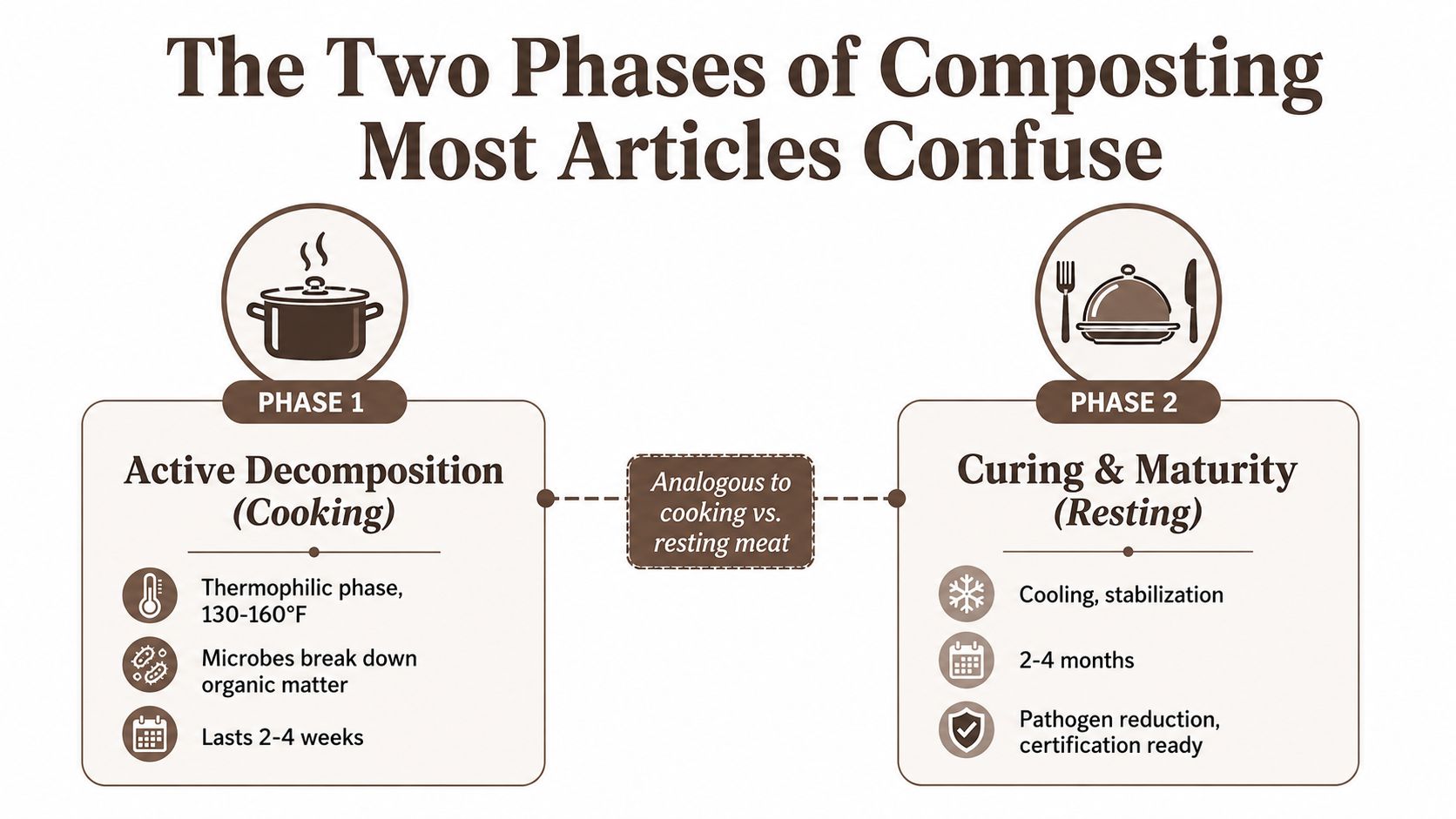
Curing is the resting stage
After the hot phase, the pile cools. Microorganisms remain active, but decomposition becomes slower and more gradual. During curing, remaining organic compounds stabilize, the texture becomes more uniform, and the compost becomes safer and more predictable to use.
Curing resembles resting a cooked meal. Food may look finished when it leaves the oven, yet resting changes its texture and allows internal processes to settle. Compost can look dark and crumbly while still requiring time to mature.
Practical rule: A material can be visibly fragmented before the compost is fully mature.
Certification tests measure defined biodegradation and disintegration outcomes under controlled conditions. A café operator must also check whether the finished output is stable, whether packaging fragments remain, and whether the receiving facility accepts the item. A short active phase does not automatically produce finished compost.
What Actually Drives Breakdown Speed in Any System
A compost pile doesn't follow a calendar by itself. Microorganisms need the right operating environment, and four variables usually determine whether a batch moves quickly or stalls.
| Factor | Target range | What happens outside the range |
|---|---|---|
| Moisture | 40% to 60% | Below 40%, microbial activity becomes limited. Excess water can remove oxygen and slow decomposition. |
| Temperature | 110°F to 160°F during active composting | Cooler conditions slow microbial work. Excessive heat can disrupt the active community. |
| Carbon to nitrogen ratio | About 25:1 to 30:1 | Too much carbon slows activity. Too much nitrogen can create imbalance and odor. |
| Oxygen | Aerobic airflow through the pile | Compaction or saturation can create oxygen-poor conditions and substantially slow the process. |
The Utah State University Extension composting guide identifies moisture, temperature, the carbon-to-nitrogen balance, and oxygen as central process controls. Think of moisture as the consistency of a wrung-out sponge. A dry pile lacks the water microbes need, while a saturated pile fills the air spaces that normally carry oxygen.
Temperature reflects activity rather than acting as an independent speed button. A warm, oxygenated pile usually processes material more actively than a cold outdoor bin, but heat only develops when the feedstock mix, moisture, and pile structure support microbial work.
The carbon-to-nitrogen ratio is the recipe. Food scraps and coffee grounds generally supply nitrogen, while dry leaves, shredded cardboard, and similar materials supply carbon. A café receiving mostly wet food scraps may need a carbon-rich amendment to avoid compaction and odor.
Oxygen is the operating discipline. Turning, loosening, or managing airflow helps maintain aerobic conditions. In practice, home piles often struggle with moisture, municipal programs with consistent operating conditions, and industrial facilities with the quality and balance of incoming feedstocks.
Home Piles, Industrial Facilities, and the Space in Between
The destination changes the timeline more than the word “compostable” on a product label.
A backyard pile may be warm and active during favorable weather, then slow when conditions become cold, dry, or neglected. A municipal program may use windrows, aerated static piles, or other managed approaches, but acceptance rules and operating practices vary. An industrial facility can control mixing, moisture, aeration, and heat more consistently, which is why its timeline can align more closely with certification testing.
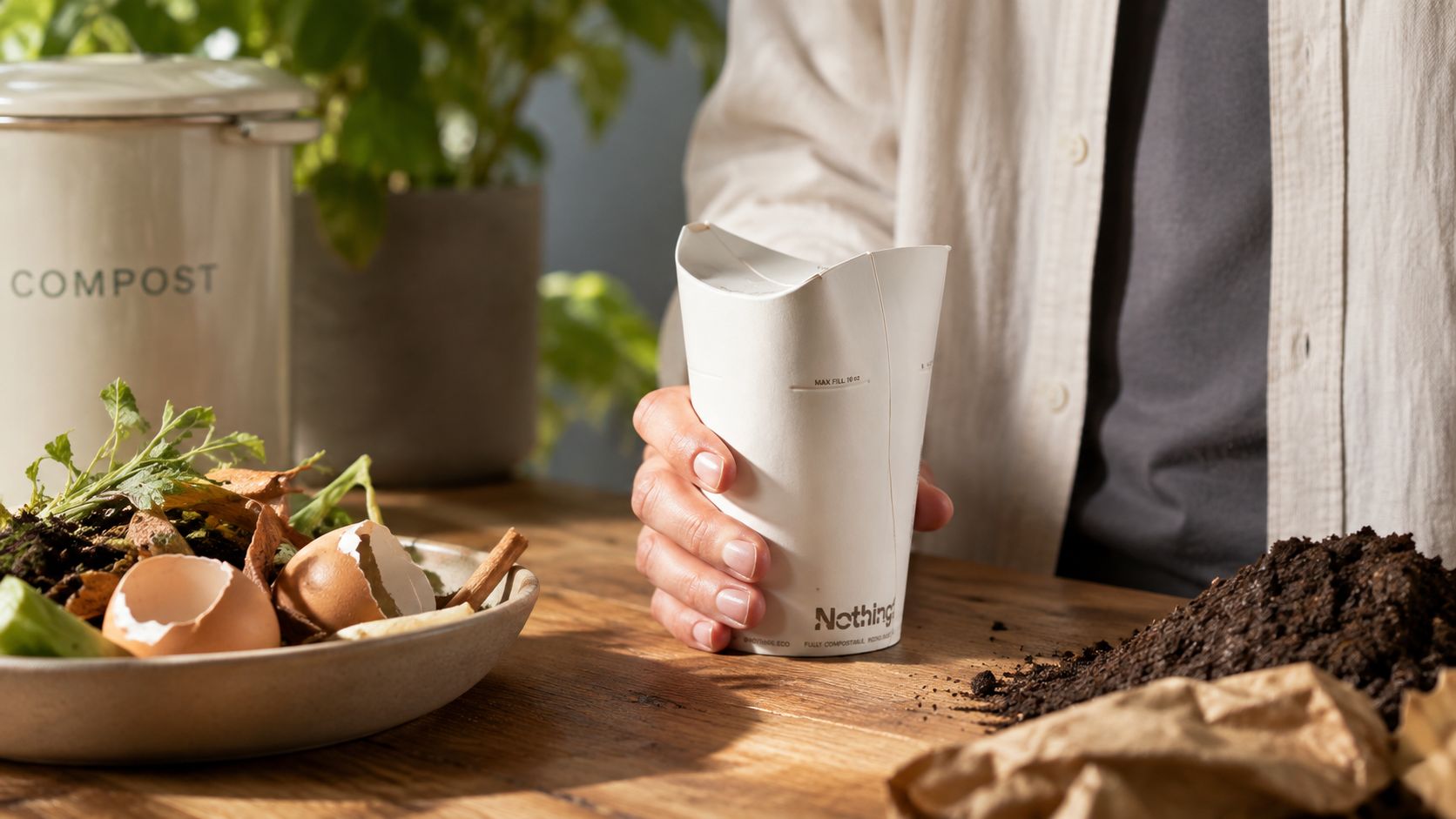
The Nothing Hot Cup is plastic-free, lid-free, and designed to disappear in 180 days.
| Environment | Temperature range | Typical timeline | What counts as “done” |
|---|---|---|---|
| Home pile | Ambient to managed warmth | Qualitatively, slower and more variable than commercial processing | Stable, mature compost with no recognizable active feedstock |
| Municipal program | Managed warmth and aeration, depending on system | Often measured in months | Material meeting the program's screening and maturity requirements |
| Industrial facility | Controlled high-heat processing | Controlled trials and municipal studies report cycles from roughly 80 to 90 days, with broader trials extending longer (municipal composting research) | Processed compost meeting facility and product acceptance requirements |
Tumblers can make turning easier, but they don't remove the need for balanced feedstock and suitable moisture. Bokashi uses a different fermentation approach before material enters soil or composting, while vermicomposting relies on worms and a suitable bedding environment. These are variants, not shortcuts that guarantee the same certification outcome.
For a café, the practical comparison is simple. Ask the hauler whether the facility accepts foodservice compostables, whether cups and straws must be certified separately, and whether the program removes packaging before processing. If you're also evaluating straw formats, a guide to paper straws for foodservice can help separate material performance from end-of-life routing.
The 180-Day Standard, Explained Without the Jargon
A café sends a used cup to a composting facility, then sees it still intact weeks later. That outcome does not automatically contradict a 180-day claim. The claim is a certification threshold, not a universal countdown clock. Under industrial compostability criteria associated with ASTM D6400, about 90% conversion of organic carbon to carbon dioxide within 180 days serves as a biodegradation benchmark in controlled conditions, as outlined in this industrial compostability claims checklist.
The benchmark asks whether tested organic carbon converted through biological activity during the specified period. It does not promise that the original cup becomes invisible on day 180, or that the product will break down wherever someone discards it.
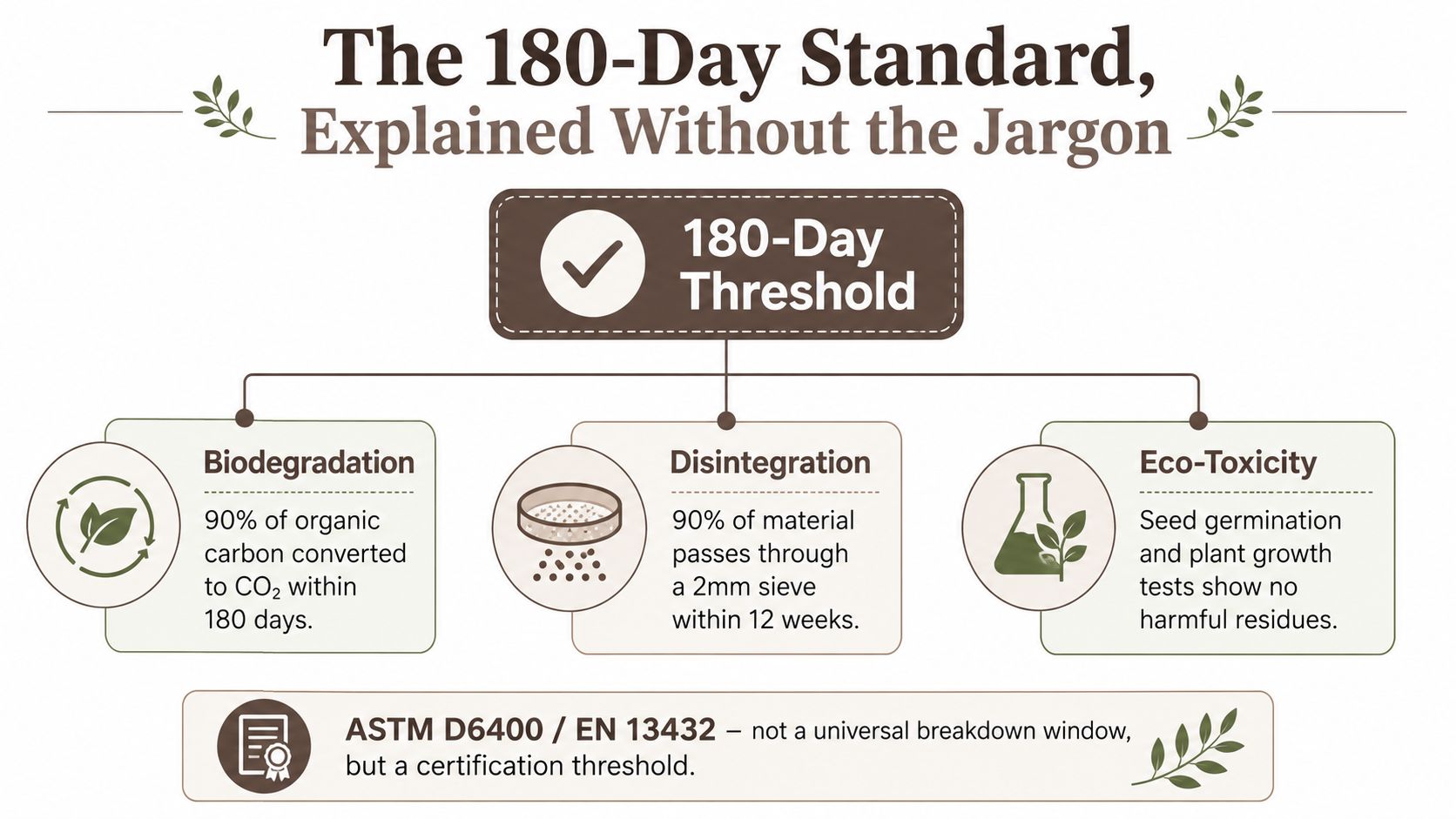
Three tests answer three different questions
- Biodegradation: Has microbial activity converted the material's organic carbon into carbon dioxide?
- Disintegration: Has the item physically fragmented enough during the required test?
- Residue safety: Do the remaining materials avoid harmful effects in relevant plant or ecological tests?
A cup can break into small pieces before its carbon has fully converted. Physical fragmentation and biological conversion are related, but they are not the same event.
The test environment supplies managed heat, moisture, aeration, and microbial activity. A café collection bin or backyard pile may be cooler, drier, compacted, or short on oxygen, so the same item can persist longer there.
For operators, certification answers only part of the question. Ask whether the composting partner runs the type of facility the certification assumes and accepts the complete product. The guide to compostable coffee cups offers product background, while the hauler's acceptance list determines the practical route.
This video visually introduces the difference between composting conditions and product claims.
How Nothing's Cups and Straws Fit the Timeline
A café shouldn't evaluate cups and straws by the same breakdown expectation. Their materials, coatings, thicknesses, and exposure to moisture differ, so the receiving system matters for each item.
Nothing cups use a water-based coating rather than a conventional plastic lining, with a design intended to disappear within the 180-day performance standard under the stated conditions.
Nothing's paper straw range is plastic-free and made without a plastic liner.
A product claim describes tested behavior. A waste route determines whether the claim can be realized.
The compostable hot cup information gives operators a product-specific reference point. Use it alongside the facility's acceptance documentation, because a material can be suitable in principle while still being rejected by a particular program.
Why “Compostable” Does Not Mean It Disappears Anywhere
“Compostable” describes performance in a defined environment. It doesn't mean a product will disappear at the same speed in a backyard bin, a landfill, or an exposed litter stream.
Industrial compostability testing relies on controlled variables such as high heat, moisture, aeration, and active microbial conditions. A household pile may be cooler, drier, compacted, or inactive for long periods. The Compost Foundation's field-testing summary highlights that temperature and moisture can matter more than test duration for compostable polymers, and that disintegration varies across real composting systems.
That gap affects customer communication. A sign that says “this cup disappears in 180 days” can mislead customers if the café has no collection route connected to a suitable facility. The statement needs context about where the item should go.
Route the item, not just the claim
- Industrial composting: The product may be processed under the controlled conditions assumed by the certification.
- Home composting: Results can be slower and less predictable unless the product carries a relevant home-composting claim.
- Landfill disposal: The item isn't receiving the aerobic composting environment used for the standard.
- Littering: Exposure to weather and biology doesn't create a controlled composting process.
For broader packaging guidance, the discussion of UK e-commerce sustainable shipping offers a useful reminder that compostable packaging claims need clear disposal instructions. The same principle applies behind a café counter: a correct material in the wrong bin still produces the wrong outcome.
Reading Your Own Conditions Like a Composting Operator
A café may be told that a cup breaks down within a stated period, yet the local facility may reject it at the gate. Set the timeline from the receiving facility backward, not from the product brochure forward. Ask whether it accepts foodservice packaging, coated paper, certified compostable plastics, and the exact cup or straw in use.
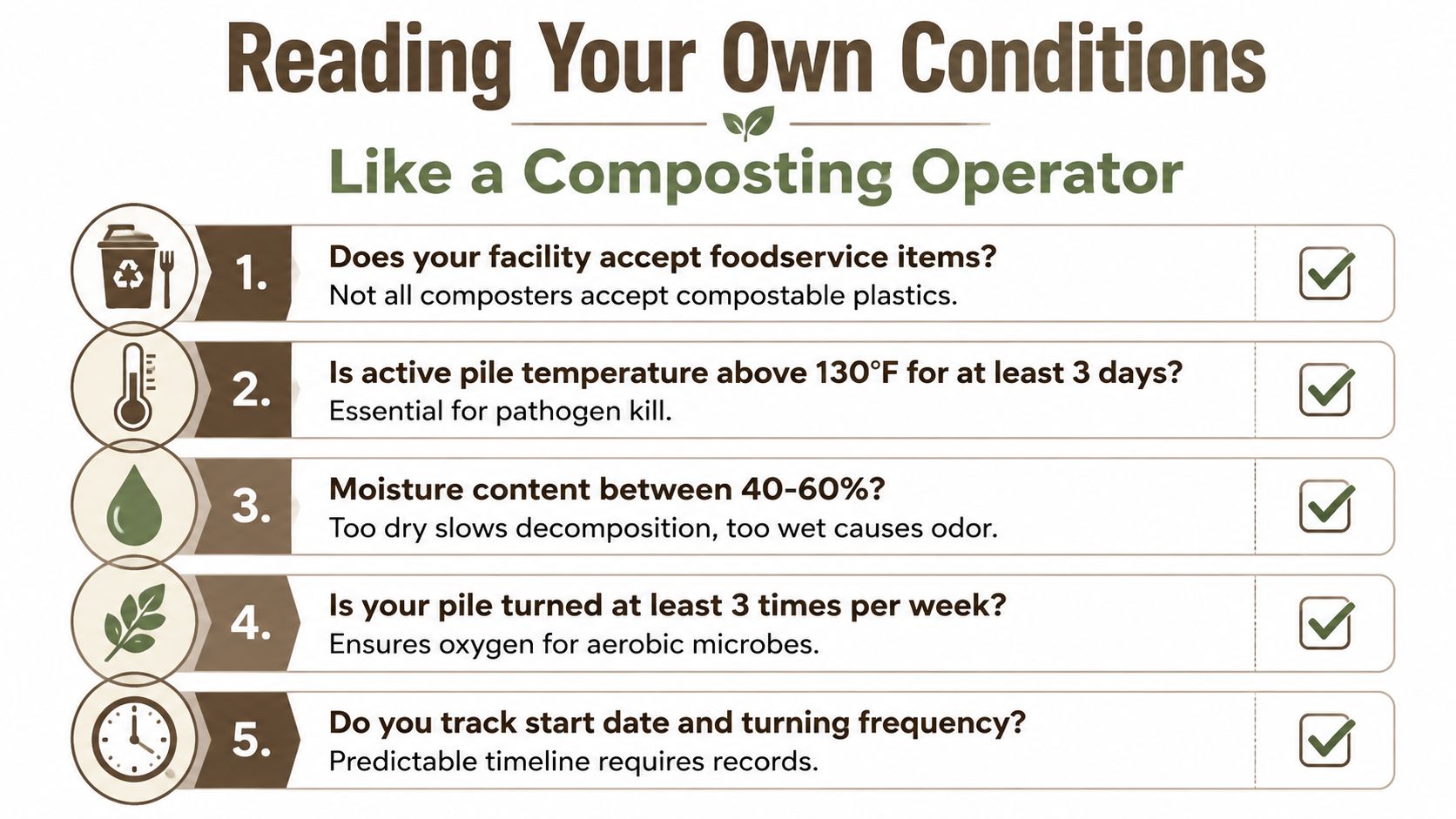
Five checks for a realistic timeline
- Confirm acceptance. Get the answer in writing where possible. A facility may accept food scraps while removing compostable packaging, or accept only specified certified items.
- Check moisture. Aim for 40% to 60% moisture, the range identified in the technical composting guidance. Dusty material is too dry for efficient activity. A saturated bin may lose oxygen.
- Review the feedstock balance. A carbon-to-nitrogen ratio near 25:1 to 30:1 usually supports active composting, with an operating target sometimes extending toward 35:1, depending on the mix. Wet food scraps need carbon-rich structure so air can move.
- Track heat where you control the pile. Active composting commonly runs around 110°F to 160°F, while thermophilic operation sits around 131°F to 160°F, as noted in the extension guidance cited above. A thermometer replaces assumptions with records.
- Match the whole item. Check the cup, coating, straw, adhesive, ink, sleeve, and lid. They should follow the same accepted certification or material pathway. One compatible component does not make the assembled item acceptable.
Keep a log of collection dates, material mix, moisture observations, temperature readings, and turning or aeration. The record can show why one batch finishes promptly while another still looks recognizable.
For café procurement, the useful question has two parts: does the item carry a compostable label, and do the material, facility, and staff instructions point to the same end-of-life route? That distinction separates a product's breakdown claim from what your operation can deliver.
If your café needs plastic-free cups and straws with clear material information, review the compostable foodservice options from Nothing. Confirm that the local hauler accepts those specific items before changing the waste program, then base signage and staff training on the receiving facility's conditions.
