


Custom Logo Disposable Cups: A Guide for Operators
More than 500 billion disposable beverage cups are consumed worldwide each year, according to the UNEP life-cycle assessment. For a café, custom logo cups are an inventory decision as well as a branding choice. Each cup leaves the counter and enters a supply chain your staff cannot control, from a customer's desk to an off-site bin. Choose specifications and order quantities that fit daily use, protect product safety, and support claims you can substantiate.
Table of Contents
- Why Custom Logo Cups Work Harder Than a Printed Logo Alone
- How Custom Logo Disposable Cups Are Printed
- Material Specs That Shape Performance and Claims
- Food-Safe Ink Choices and Migration Controls
- Order Size, Inventory, and Total Landed Cost
- What Your Compostable Claim Can and Cannot Say
- How to Choose a Supplier for Consistent Brand Identity
- Your First Custom Order Checklist
Why Custom Logo Cups Work Harder Than a Printed Logo Alone
The category is enormous, and that scale is why small specification choices matter. The UNEP life-cycle assessment puts global use at more than 500 billion disposable beverage cups a year, including roughly 250 to 300 billion paper cups with plastic linings. Your shop won't move numbers like that, but your cup follows the same path. It's handed over, carried in public, photographed, and discarded away from your store.
A Cup Travels Further Than Your Sign
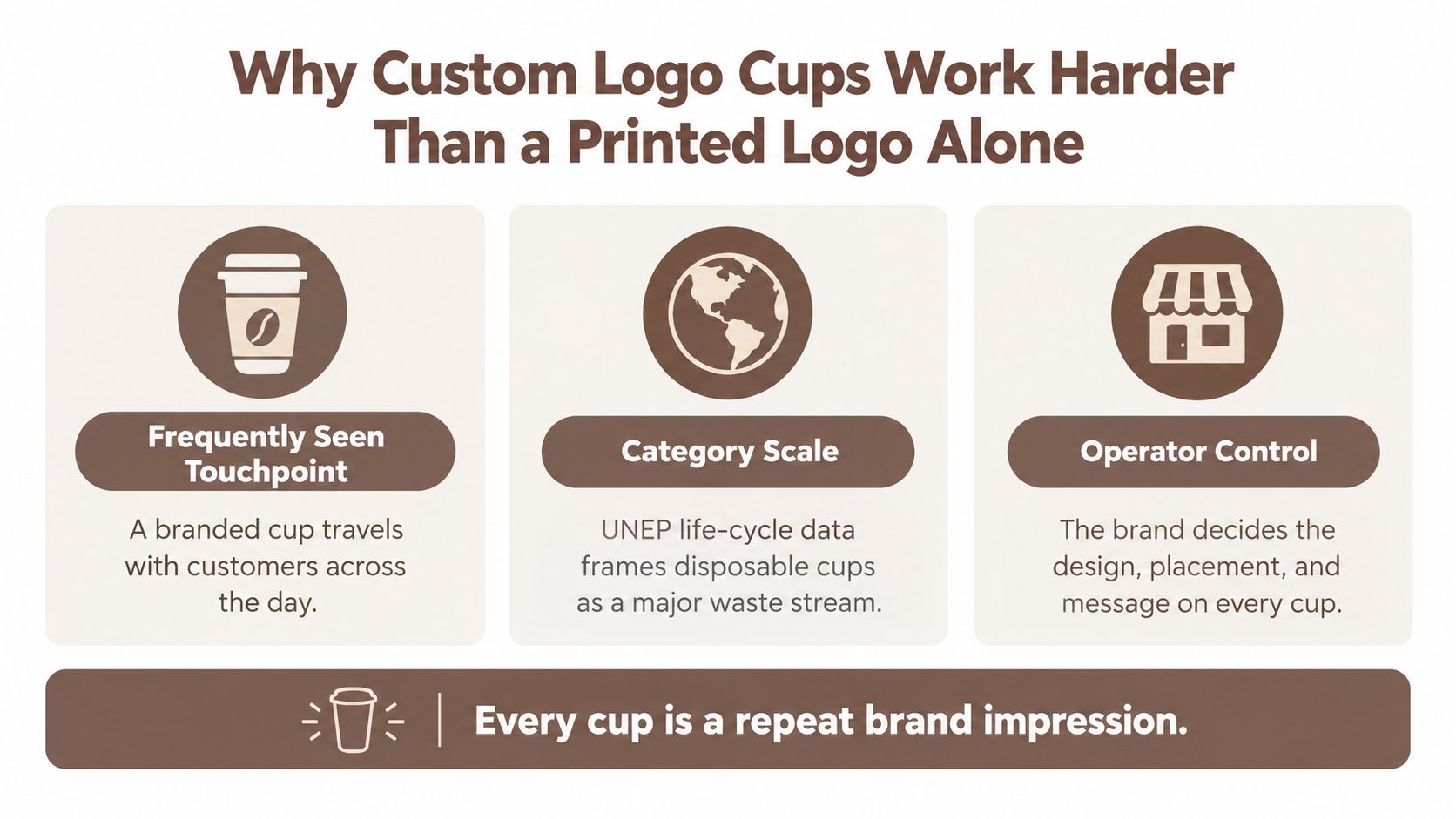
A sign works on people who pass your door. A cup works on people who never do. It goes into offices, cars, trains, and neighboring businesses, and it's held at eye level by the person drinking. That repeated exposure is what builds recognition, provided the design is consistent enough to be recognized at a glance.
Consistency is where many operators lose the value. If one location uses current artwork, another uses an older run, and a third falls back on blanks, customers see three different brands. Colors drift, logos shrink, and the cup stops reinforcing anything. The impression still happens, but it doesn't compound.
Define What You're Actually Buying
A fully custom printed cup has your artwork printed on the blank before forming, so placement, color, and messaging are fixed in production. A plain cup with a sticker or printed sleeve is a different product, with different labor, alignment, and waste implications. Both can work, but they aren't interchangeable, and comparing them on unit price alone hides the operational differences.
Every cup is a repeat brand impression, whether you planned the design or not.
That's the framing for everything that follows. The cup is a branding surface, a food-contact package, and a stock item at the same time. Buy it as all three, not just the first.
How Custom Logo Disposable Cups Are Printed
Three routes cover most operator needs. The right one depends on how many cups you use, how often artwork changes, and how much detail your design requires. Think of plate-based printing as a rubber stamp built for thousands of impressions, and digital printing as a home printer making one good page at a time. The stamp is cheaper per impression once it's made. The printer wins when the message keeps changing.
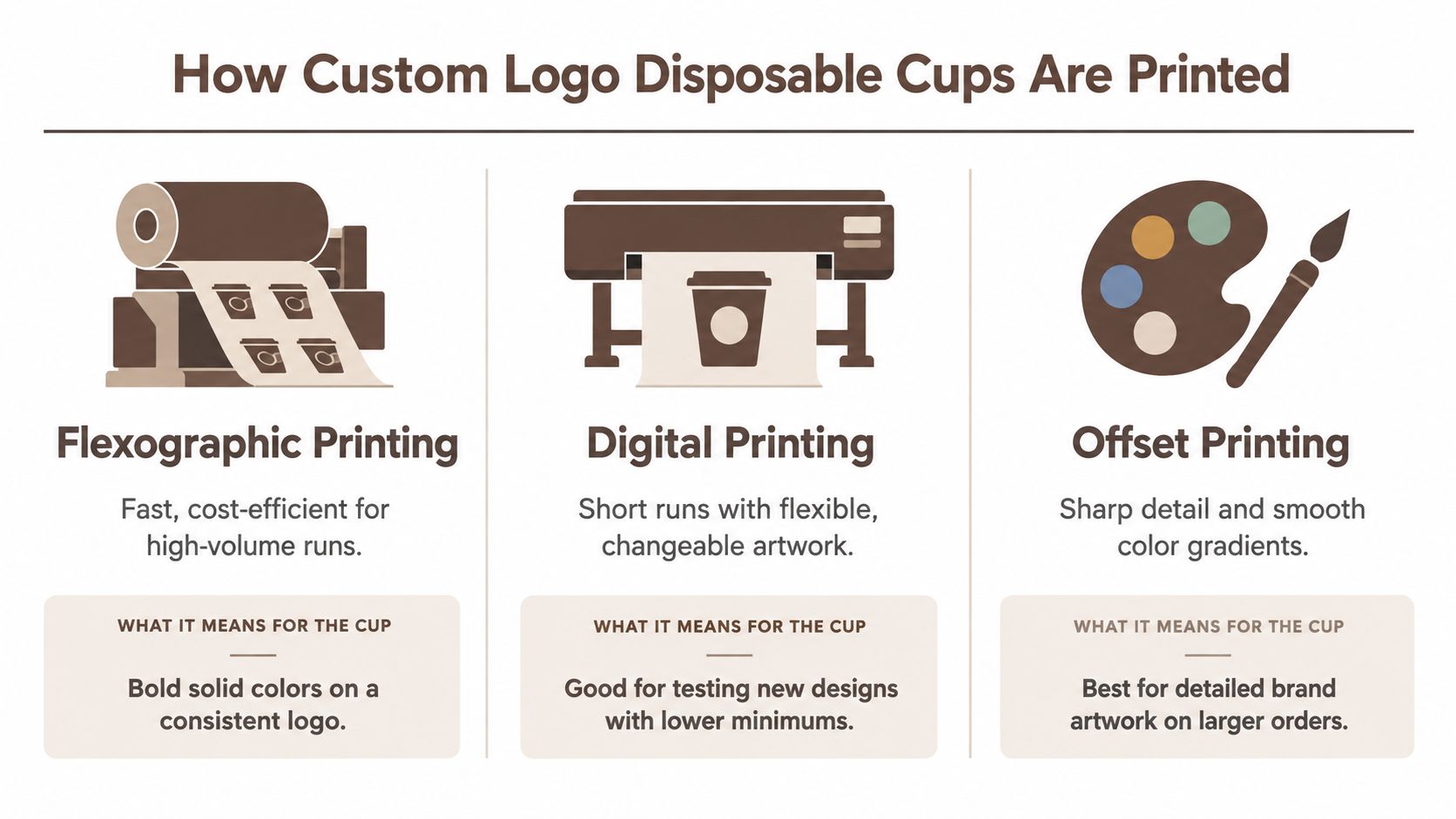
Plate-Based Printing for Stable Volume
Flexographic and offset printing use plates, so setup cost is real and needs volume to spread across the run. In return you get consistent color and clean reproduction when the same artwork repeats order after order. This suits a multi-location brand with a fixed logo and predictable demand. It punishes frequent redesigns, because every change starts the setup logic again.
Digital Printing for Shorter Runs
Digital methods need little tooling, so they support smaller runs and seasonal or promotional artwork. That's useful for a single café testing a design, a rotating menu, or an event venue that can't commit to months of one graphic. Fine detail and photographic effects are easier to attempt, but you still need a physical sample. Screen proofing won't show how ink sits on a curved, coated surface.
Blank Cups Plus Labels or Sleeves
This is the most flexible route and often the most labor-heavy. You can change messaging without scrapping printed cup stock, and you can brand only the volume you need. The trade-off shows up at the counter. Crooked labels, peeling edges, and extra handling slow service and look improvised.
- Choose plate-based printing when artwork is stable and volume is high enough to absorb setup.
- Choose digital printing when runs are short or designs change often.
- Choose blanks plus labels when flexibility matters more than a polished finish.
Match the method to your usage pattern first. Color range and detail come second.
Material Specs That Shape Performance and Claims
A paper cup isn't just paper. It's fiber plus a barrier coating plus a print layer, and the three behave as one system. The coating keeps liquid in for the service period. It also largely determines what happens after disposal, which is why a claim based on paper content alone isn't enough.
Plastic-lined cups use a polyethylene layer that holds liquid reliably but complicates recovery. Water-based and wax-based coatings aim to do the holding job while staying compatible with a composting or biodegradation pathway. Neither approach should be accepted on a label. Ask what the coating is, how it's applied, and under what test conditions it held liquid without leaking.
What a Laboratory Example Shows
The trade-off is concrete in a laboratory study where a 0.70 mm beeswax coating retained cold water for at least 30 minutes, while the biodegradable coated cup fully degraded in active soil within 5 weeks and damp sand within 6 weeks, versus a delayed polyethylene-coated control. That doesn't prove every wax-coated cup performs the same way. It shows what to require: a stated coating, a stated thickness, a stated hold time, and a defined environment for degradation.
If you're evaluating compostable options in detail, this overview of compostable coffee cups is a useful companion to a supplier spec sheet. For a different substrate entirely, the Custom Mark stadium cup guide covers reusable plastic formats where the material questions are different.
Build a Buyer Checklist
- Coating identity: Name the material, don't accept a generic eco description.
- Basis weight or thickness: Get the number that defines the barrier.
- Hold-time conditions: Confirm liquid type, temperature, and duration tested.
- End-of-life evidence: Require independently defined compostability or biodegradation support.
Don't leave the print layer out of that review. Varnishes and heavy ink coverage sit on the same surface and can affect barrier behavior and end-of-life claims. A biodegradable fiber under an incompatible print system is still a problem.
Food-Safe Ink Choices and Migration Controls
Exterior printing isn't automatically food-safe just because it faces outward. Paper is porous, and the layer structure matters more than which side carries your logo.
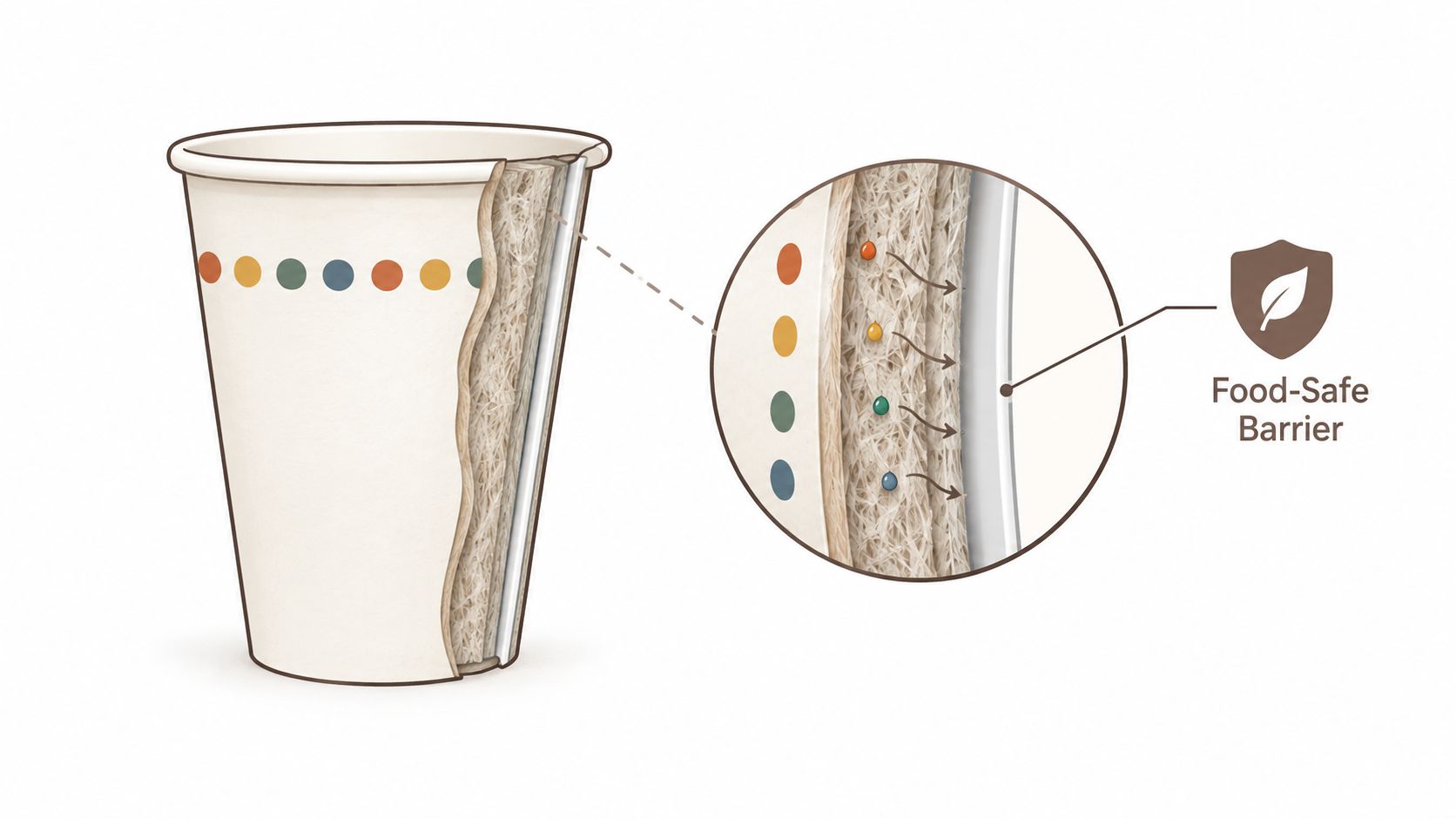
Ink constituents can migrate through the substrate, transfer through the gas phase, or set off onto another surface when cups are stacked and nested under pressure. That last route is easy to overlook. A printed outer wall presses directly against the food-facing inner wall of the next cup in the stack, through packing, shipping, and storage.
What Your Specification Should Require
German Federal Institute for Risk Assessment guidance summarized in research on paper food-contact materials notes that paper and cardboard normally provide low barrier effectiveness, so branded cup specifications should require food-packaging-suitable inks, documented composition, controlled print coverage, and migration testing. Testing should use relevant food simulants under realistic time and temperature conditions. A cold-drink cup and a hot coffee cup don't present the same exposure.
Dense dark colors, metallic effects, and full-coverage graphics raise the stakes because higher ink loading means a larger potential migrant source. That doesn't ban bold design. It means bold design needs stronger documentation.
The video below is worth watching before you approve artwork, as a prompt for questions to put to your printer.
Ask three practical questions. Is this ink system made for food packaging, and can you document its composition? How much print coverage does my artwork create, and can we reduce ink-heavy areas? How do you keep uncured printed surfaces away from the food-facing side during production and packing? A supplier who can't answer clearly shouldn't print your cup.
Order Size, Inventory, and Total Landed Cost
The lowest per-cup price is often the most expensive decision in the building. Large runs lower the unit number and raise storage, cash tied up in stock, and the cost of any artwork change. For an independent café or a seasonal venue, that's not a saving. It's a warehouse problem with your logo on it.
Lead time compounds the issue. Packaging guidance notes production can take roughly 3 to 6 weeks after proof approval, and ordering 5,000 cups for consumption of 200 per month can create more than two years of stock. The same guidance recommends holding only 3 to 6 months of inventory. Two years of cups outlives price changes, menu changes, and sometimes the lease.
Months of Supply by Order Size at 200 Cups per Month
| Order Size | Monthly Usage | Months of Supply |
|---|---|---|
| 1,000 | 200 | 5 |
| 3,000 | 200 | 15 |
| 5,000 | 200 | 25 |
Run your own version before you request quotes. If the months column makes you uneasy, the unit price is irrelevant.
Inputs for a Demand-Planning Calculation
- Location count and daily usage: Model each site separately, since uneven demand strands stock.
- Seasonality: A summer peak order becomes dead space in winter.
- Design-change frequency: Every planned promotion shortens the useful life of a run.
- Storage cost and spoilage: Count the shelf, not just the invoice.
- Expected over- or under-runs: Confirm how production variance is handled and charged.
This is also where format choices elsewhere in your operation matter, and this guide to eco-friendly food packaging helps you compare the cup decision against the rest of your disposables. Model total landed cost per usable cup, including the ones you'd throw away after a rebrand. That's the number to negotiate.
What Your Compostable Claim Can and Cannot Say
A compostable claim is a promise about a system, not just a material. Certification, local collection, facility acceptance, and customer behavior all have to line up. When they don't, the artwork on your cup can mislead people even if the cup itself was made responsibly.
The regulatory picture doesn't make this easier. NSF describes a fragmented certification landscape and inconsistent state regulations, while the foodservice disposable market is projected to grow 3.8% annually to $33.2 billion by 2027. More volume under inconsistent rules means more chances for a claim that's accurate in one city and wrong in another.
A cup can carry a credible compostability certification and still fail its intended outcome if it lands in landfill-bound trash or a contaminated organics bin.
Map the Decision by Market
Start with certification and labeling requirements where each location operates. Then confirm whether accepted industrial composting infrastructure exists there and whether the facility takes foodservice cups. Finally, decide what disposal instruction you can truthfully print or post at the bin. If there's no organics collection, the most defensible instruction may be no composting claim at all.
Operators also ask whether logos, inks, coatings, QR codes, and promotional copy affect certification or sorting. They can, because certification applies to the finished article, not the blank underneath your artwork. Get the answer for your printed cup in writing before you commit, and keep the evidence file with the artwork.
Governance matters as brands grow, which is why larger groups invest in oversight such as ESG training for board members alongside packaging policy. For the cup-specific side, this breakdown of the eco-friendly paper cup helps separate material claims from disposal reality. Print only what you can support at that address, on that day, in that bin.
How to Choose a Supplier for Consistent Brand Identity
A cup program can drift before customers notice the cause. One site reorders late and buys locally; another accepts a close color match. Soon, the same brand looks different across locations. Supplier choice affects that risk, as well as how much stock each site must carry.
Criteria That Protect Consistency
- Color-matching standards: Ask how future runs will be matched to the approved sample.
- Artwork file requirements: Confirm templates for every cup size, since the print area changes with the cup's curve.
- Sampling before production: Approve a physical cup, not just a screen proof.
- Minimums that suit smaller sites: If the smallest location cannot meet the order minimum, staff may buy substitutes.
- Lead times and reorder process: Check reorder timing against each site's stock on hand.
- Documentation: Store material specifications and food-contact declarations centrally.
Three Supplier Models
Stock blanks with third-party labels are quick to start, but offer less control. Label placement can vary between staff and locations. Fully custom runs from one manufacturer give tighter control over color, placement, and cup construction, though minimum orders can leave slower sites holding stock longer. A stock cup with a printed sleeve sits between those options. It can reduce waste when artwork changes, but adds another item to order, store, and assemble.
One custom option is Nothing, a Miami-based supplier of compostable lidless cups and custom printed cups, sleeves, and straws. Its Hot Cup is described as plastic-free and lid-free, with a folding lid and spout, and as designed to break down within 180 days under real-world conditions. The supplier also lists PFAS-free and wax-free materials with a water-based coating. It offers sampler kits credited toward a first order, ordering in USD and CAD, and free standard shipping on qualifying U.S. orders. These are supplier-stated features. Check them against a physical sample and the specification sheet before choosing the cup. The catalog lists 3 variants across option1, option2, and option3.
Set one approved sample, one color reference, and one specification sheet as the standard. Use them to check every reorder, and share the same references with purchasing teams at every location.
Your First Custom Order Checklist
Treat the first run as an operating decision, not only an artwork approval. Work through the specifications before committing stock.
- Pick the printing route: Match plate-based, digital, or blank-plus-label printing to your monthly usage and expected reorder needs.
- Require material documentation: Request the coating identity, thickness, hold-time test results, and print-layer details.
- Confirm ink controls: Ask for food-packaging suitability, ink composition, coverage limits, and migration testing.
- Set an inventory ceiling: As an operating ceiling, cap the order at roughly 3 to 6 months of expected use per location, then adjust for local demand and storage constraints.
- Write claim language last: Match each environmental statement to the disposal route available at that location.
Test Before You Commit
Request a sampler kit and run your own drinks through it at service temperature. Check lid or spout fit, hold time before softening or leaking, and print appearance in a customer's hand and in photos. Test at more than one location if possible. Water, storage, and handling can vary between sites.
Keep a record of the approved product. Store the signed proof, physical sample, color reference, and spec sheet together, then share copies with everyone who places reorders. That gives each location a common standard and makes later checks more reliable than memory.
Start with a small run, confirm performance in service, then increase the order. This limits the cost of discovering a fit, print, or handling problem after stock has arrived.
Nothing offers sampler kits, custom printed cups, sleeves, and straws, along with lidless cup options made with plastic-free, PFAS-free materials and a water-based coating. You can assess print appearance, fit, and hold time before placing a full custom order. To review its sampler and custom design options, visit Nothing.
