


Eco Friendly Paper Cup Guide: What Actually Counts
A café manager is comparing three cup quotes before the morning rush. Every supplier has printed “eco friendly” on the specification sheet, yet one cup has a plastic liner, another claims compostability without naming a certification, and the third provides a coating description but no PFAS test report. The prices are easy to compare. The environmental claims aren't.
That confusion is understandable. A paper cup isn't one material with one environmental outcome. It's a fiber body, a liquid barrier, inks, adhesives, and a disposal route that may or may not exist where the cup is used. This guide gives operators a practical way to evaluate an eco friendly paper cup by looking past recycling-bin icons and focusing on coating chemistry, PFAS verification, certifications, and actual end-of-life handling.
Table of Contents
- Why the Eco Friendly Paper Cup Question Matters Right Now
- What Actually Makes a Paper Cup Eco Friendly
- Coatings, Linings, and the Barrier Layer Problem
- PFAS in Paper Cups and What PFAS Free Really Means
- Reading Certifications Without Getting Misled
- End of Life Pathways and Where Cups Actually End Up
- Evaluating Claims and Choosing Cups That Hold Up
Why the Eco Friendly Paper Cup Question Matters Right Now
The conventional paper cup has a structural problem. Researchers estimate that less than 1% of used paper coffee cups are recycled worldwide, despite paper being one of the most recycled municipal materials overall, as documented in this review of single-use paper coffee cups. The paper fiber isn't necessarily the main obstacle. A thin plastic liner bonded to that fiber makes the cup a composite product that ordinary paper recovery systems may struggle to process.
The volume makes procurement decisions consequential. One widely cited UK benchmark reports that about 7 million paper cups are used and disposed of every day, totaling roughly 2.5 billion annually and producing around 30,000 metric tons of coffee-cup waste each year, according to the same review. A separate estimate places worldwide cup use at 250 billion cups annually, which explains why a small design improvement can matter when adopted across foodservice.
The label no longer does enough work
Operators face pressure from several directions. Customers ask about plastic reduction, municipalities change accepted materials, and policymakers continue to examine single-use packaging through measures such as plastic restrictions and producer-responsibility rules. Guidance on the changing landscape of plastic bans illustrates why a cup that once passed as “paper” may now receive closer scrutiny.
A generic claim can also create operational risk. If a supplier says “compostable,” does that mean industrial composting only? If the cup enters a recycling stream, can the coating be repulped? If the package says “PFAS-free,” does that describe the entire finished cup or only one coating batch?
Buyer's rule: Treat “eco friendly” as an opening question, not as evidence.
Use a procurement checklist
Before approving a cup, ask for four pieces of information:
- Material construction: What fiber is used, and what is the barrier layer?
- Chemistry evidence: Is the coating plastic-free, water-based, wax-free, and tested for PFAS?
- Certification scope: Does the certification cover the finished cup, including inks and adhesives?
- Local routing: Will your waste contractor send the cup to a paper mill, an industrial composting facility, landfill, or incineration?
The right purchase isn't automatically the cup with the greenest appearance. It's the cup whose material claim, test evidence, and disposal route agree with one another.
What Actually Makes a Paper Cup Eco Friendly
A café serves a hot drink during a busy morning rush. The cup looks like paper, but its performance and disposal route depend on two layers: the fiber substrate forms the wall, while the barrier coating keeps liquid and condensation from passing through. That hidden layer often determines whether the cup can be repulped, composted, or treated as residual waste.
The technical contrast is straightforward. A water-based barrier may let paper fibers separate during repulping, while a PE film can remain bonded to the fiber and create a difficult composite. Cups with the same paper appearance can therefore require different equipment, waste routes, and handling decisions. The eco friendly paper cup label means little until the barrier chemistry is identified.
Start with the fiber, then inspect the lining
Fiber sourcing still matters. A specification may identify virgin pulp, recycled fiber, or pulp certified through a forestry chain-of-custody program such as FSC. Buyers can also ask how the fiber was bleached and whether the manufacturer provides chemical and food-contact documentation. These details support responsible sourcing and product safety, but they do not establish compostability.
The coating must be named. “Natural lining,” “green barrier,” and “plant-based protection” are marketing descriptions until the supplier identifies the chemistry and provides supporting documents. A water-based coating may be designed for repulpability, whereas a plastic film can block fiber recovery even when the exterior appears fully paper-based.
For product-level comparison, the Hot Cup is plastic-free and lid-free, with a folding lid and spout designed to disappear in 180 days. Its catalog lists three size variants.
A cup can contain responsibly sourced paper and still fail an operator's sustainability goal. The guide to compostable hot cups illustrates why the material claim, coating, certification, and available disposal facility need to align.
Working definition: An eco friendly paper cup is more than a paper cup: it has documented fiber sourcing, clearly identified barrier chemistry, verified safety claims, and an end-of-life route that exists where it will be used.
Coatings, Linings, and the Barrier Layer Problem
The barrier layer controls the cup's relationship with liquid and waste infrastructure. Polyethylene, PLA, wax, aqueous coatings, and mineral-based systems don't behave the same way in paper mills or composting environments, so a buyer should compare them by pathway rather than by label color.
Traditional PE lining gives strong liquid resistance and familiar performance, but it bonds paper to plastic. PLA is a bio-based polymer often used in compostable packaging, yet its breakdown depends on suitable industrial composting conditions. Wax can provide moisture resistance and biodegradability in some contexts, but it has limited relevance for demanding hot beverage applications.
A practical comparison
| Coating Type | Recyclable in Paper Mills | Compostable (Industrial) | PFAS-Free | Heat Resistance | Typical Use Case |
|---|---|---|---|---|---|
| PE plastic film | Difficult in many fiber systems | No general compostability claim | Not implied | Strong | Conventional hot and cold cups |
| PLA film | Limited by facility and process | Requires suitable industrial conditions | Not implied | Suitable for specified foodservice uses | Composting-targeted cups |
| Wax | Limited or unsuitable for many recovery systems | Can be biodegradable, depending on formulation | Not implied | More limited for hot drinks | Moisture-resistant specialty packaging |
| Water-based or aqueous coating | Generally designed for repulpability | May be compostable in industrial facilities, depending on formulation | Must be verified separately | Formulation-dependent | Recyclable or compostable fiber cups |
| Mineral-based barrier | Formulation-dependent | Formulation and certification-dependent | Must be verified separately | Formulation-dependent | Emerging barrier applications |
A technical review reports that cups with latex or water-based barrier coatings are generally recyclable and repulpable, and may be compostable in industrial facilities, while conventional plastic-lined cups remain difficult to recover at scale. The review also describes newer cups as capable of being over 90% biodegradable under industrial composting conditions, but that figure applies to the reviewed technologies and conditions, not to every product marketed as compostable. See the technical review of coating and recovery behavior.
Performance still matters
A lower-impact coating isn't useful if the cup softens, leaks, or changes the drink's taste during normal service. Ask for hot-fill and cold-condensation test data, then test samples in your own workflow. A product such as the Cold Cup is described in its catalog as plastic-free, lid-free, and designed to disappear in 180 days, with four variants across option1, option2, and option3.
The coating comparison should end with two questions. Is the barrier designed for the route you can access? And has the supplier separately verified that the chemistry is PFAS-free?
PFAS in Paper Cups and What PFAS Free Really Means
A cup can pass an industrial compostability test and still raise a chemistry question. “Compostable” describes what should happen at end of life. It does not, by itself, confirm that the coating contains no fluorinated treatment. PFAS may enter fiber packaging through grease-resistant additives, contaminated inputs, or recycled material. Buyers therefore need to assess both breakdown behavior and the substances carried into that process.
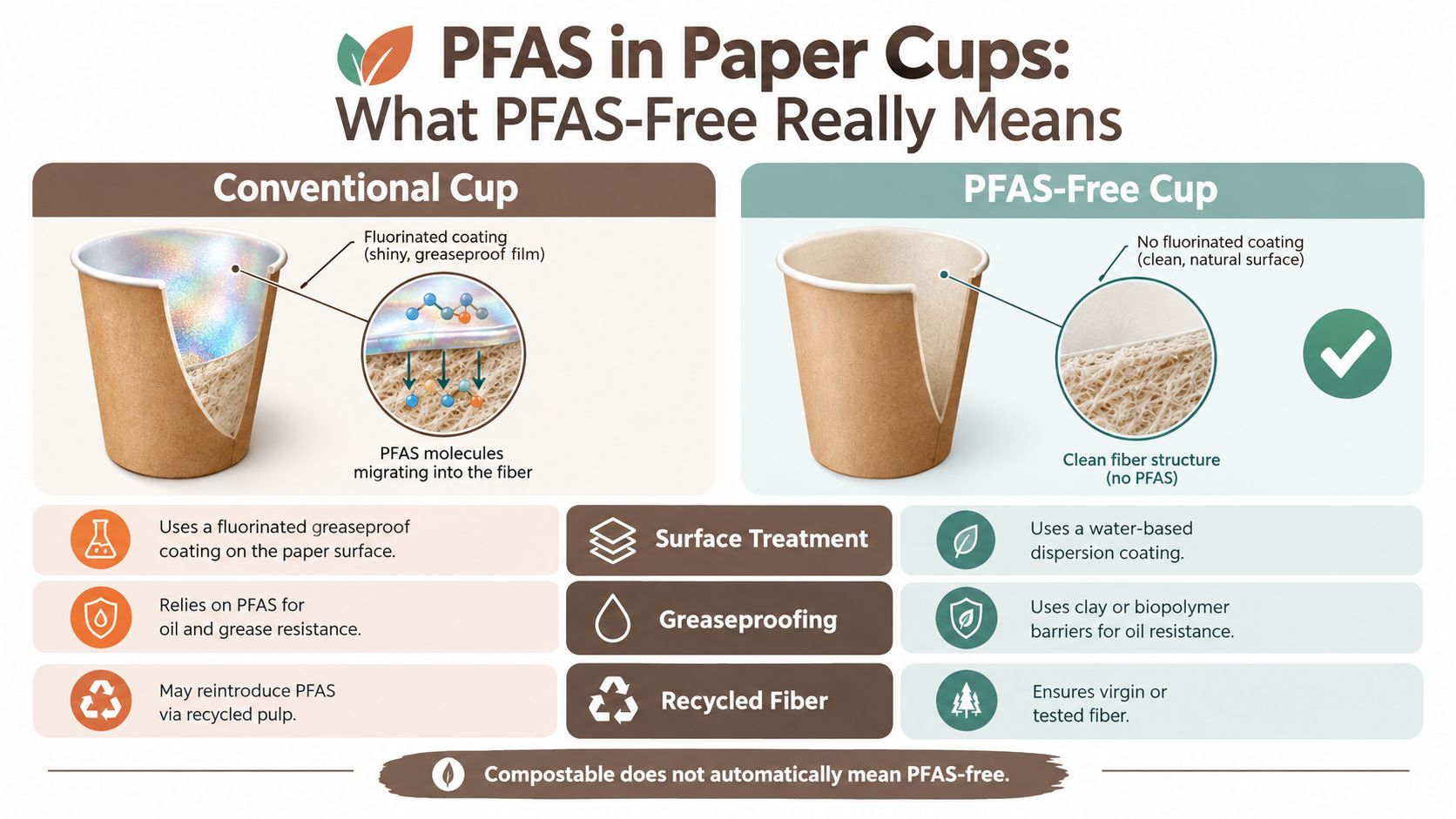
Independent reporting on compost samples from five U.S. states found about 10 times more perfluoroalkyl acids at facilities accepting food packaging than at facilities that did not accept it, according to Popular Science's coverage of PFAS in compostable packaging. The finding does not prove that every compostable cup contains PFAS. It does show why a compostability logo cannot substitute for finished-product chemistry records.
Read the claim carefully
PFOA-free and PFOS-free statements address named chemicals. They do not necessarily cover the broader PFAS family, including short-chain alternatives. A narrow claim can therefore leave relevant chemistry outside the stated scope.
Ask the supplier for four kinds of evidence:
- Finished-product testing: Results should cover the cup, coating, inks, and other relevant components, rather than only the paper stock.
- Method clarity: Confirm whether testing used targeted PFAS analysis, total fluorine screening, or both.
- Threshold disclosure: Certification frameworks such as BPI require total fluorine at or below 100 ppm, verified through total organic fluorine testing. Confirm which requirement and test method apply to the supplied product.
- Independent documentation: Request the laboratory report, detection limits, sample identification, and test date.
The USDA's 2025 report on compostable materials notes that compostable products can contribute PFAS to compost. An RSC analysis cited in that report found PFAS in 1 of 15 paper samples and 8 of 14 bagasse samples. Fiber content alone therefore does not establish low chemical risk.
“PFAS-free” becomes useful procurement evidence only when it identifies the tested product, test scope, method, and threshold. Without those details, the label signals an intention, not a verified result. A buyer should match the documentation to the exact cup specification and confirm that any reformulation triggers retesting.
Reading Certifications Without Getting Misled
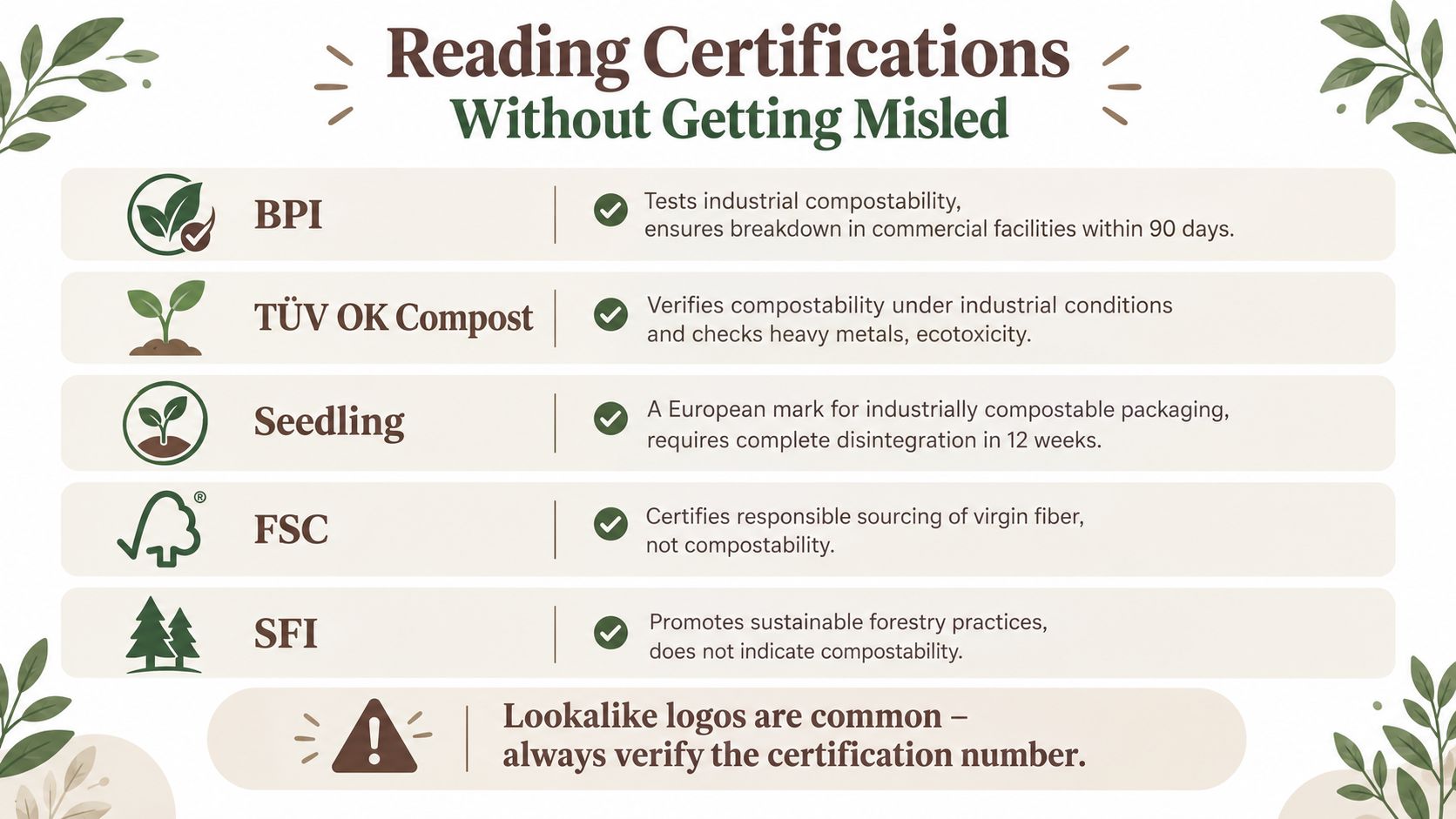
A certification logo answers a defined question. It doesn't certify every environmental attribute of the package. FSC and SFI address forestry practices or fiber sourcing, while compostability marks address breakdown under specified conditions. Confusing those functions is one of the easiest ways to overread a package label.
Match the mark to the claim
BPI is associated with industrial compostability. TÜV OK Compost and the European Seedling mark also address compostability under defined industrial conditions, while FSC concerns responsible sourcing of virgin fiber and SFI promotes sustainable forestry practices. None of those marks, by themselves, proves that a cup is home-compostable, recyclable in your local paper mill, or PFAS-free.
A buyer should ask what the mark covers:
- BPI: Verify the product certificate and whether the finished cup is included.
- TÜV OK Compost: Check the applicable industrial compostability scope and supporting requirements.
- Seedling: Confirm that the European certification applies to the exact product and market.
- FSC: Use it to assess responsible fiber sourcing, not end-of-life behavior.
- SFI: Treat it as a forestry-practice signal, not proof of compostability.
Request the paperwork behind the logo
Don't accept a logo image as the complete record. Ask the supplier for the certificate number, expiration date, product name, construction details, and certifying body's accreditation scope. If the vendor references ASTM D6400, ASTM D6868, or EN 13432, request the underlying compliance report and confirm whether the test covers the coated article rather than paperboard alone.
Red flags include:
- Self-created seals: A leaf icon or “eco choice” badge without an independent issuer.
- Expired certificates: A valid-looking mark attached to an outdated document.
- Partial coverage: Certification for a raw material that doesn't include the finished cup.
- Unclear conditions: “Compostable” with no statement about industrial facilities.
- Missing product identity: A report that doesn't match the supplier's cup construction.
A responsible supplier should be able to connect the logo, certificate, test report, and exact product specification. If those documents don't align, pause the order.
End of Life Pathways and Where Cups Actually End Up
The same cup can have different environmental outcomes in different regions. Material selection matters, but collection, sorting, hauling, and facility acceptance decide what happens after a customer drops the cup into a bin.
Consider three operating environments. A Seattle café with a contracted commercial composting route may be able to send a certified compostable cup to an industrial facility. A suburban Atlanta store may have no practical cup-compositing route, so the same item could go to landfill. A European operator connected to an industrial composting network may have access to a route that matches a relevant certification.
Use the route as the decision filter
| Cup Type | Compost Region (Seattle) | Landfill Region (Atlanta) | EU Industrial Network |
|---|---|---|---|
| PE-lined paper cup | Usually a contamination risk unless the hauler accepts it | Likely residual waste | Depends on local collection and mill capability |
| PLA-lined compostable cup | Requires facility acceptance and suitable processing | Likely residual waste if no compost route exists | Potentially suitable where certification and infrastructure match |
| Water-based barrier cup | May be accepted if the facility approves it | May still be residual waste without a collection route | Potentially recyclable or compostable, depending on certification and facility |
| PFAS-verified fiber cup | Better fit for an approved compost route | Reduces concern about uncertain fluorinated chemistry, but doesn't prevent landfill | Supports a documented composting or fiber-recovery strategy |
PE-lined cups often become a recycling dead end because the plastic film complicates fiber separation. PLA-lined cups need the right industrial conditions and a facility that accepts them. A compostable label can't redirect a cup automatically.
Write the routing instructions
Operators should ask the waste contractor three direct questions:
- Does the facility accept this exact cup?
- Is the cup processed as fiber, compostable packaging, or residual waste?
- What customer-facing bin instructions prevent contamination?
The compostable coffee cup guidance is useful context, but local confirmation still controls the decision. If a facility won't accept a material, choosing it for its label alone may increase sorting errors rather than reduce waste.
The practical hierarchy is simple. If a verified industrial composting route exists, choose a certified cup that the facility accepts. If no route exists, prioritize transparent, PFAS-tested construction and avoid assuming that a recycling icon guarantees recovery. Document the route in staff training, signage, and supplier records.
Evaluating Claims and Choosing Cups That Hold Up
A vendor deck is a starting point, not a verdict. The strongest buying process treats every environmental statement as a question that needs a matching document, sample, or operating test.
Begin with the technical file. Ask for reports tied to ASTM D6400, ASTM D6868, or EN 13432 where those standards apply, and check that the report covers the finished cup. Confirm the laboratory identity, report date, sample description, and whether the certificate is still valid. A raw paperboard report can't establish what happens to a paperboard cup after a coating, ink, adhesive, or printed finish is added.
Build a short vendor scorecard
Use a simple record for each supplier:
- Construction: Record the substrate, coating name, coating location, and any separate lid or sleeve.
- PFAS evidence: Ask whether testing used targeted analysis, total fluorine, or both. Record the threshold and whether the result applies to a finished cup or a coating batch.
- End-of-life proof: Match the certification to your actual composting or recycling contractor.
- Performance: Test hot coffee, cold drinks, condensation, stacking, and transport. Look for leaks, warping, soft walls, off-flavors, and difficult opening behavior.
- Operations: Compare case dimensions, storage needs, lead times, minimum order requirements, and unit cost.
- Traceability: Note country of origin, manufacturer identity, batch information, and product revision.
Order samples before committing to a large shipment. Run a soak-and-stir test with the drinks your team serves, then leave filled cups in realistic holding conditions. The goal isn't to create a laboratory certification. It's to catch practical failures before customers do.
Keep the public claim narrower than the evidence
If the paperwork proves an industrial compostability certification, say that. If it proves PFAS testing under a defined method, describe that scope. Don't convert FSC sourcing into a compostability claim, and don't turn “plastic-free” into a promise that every local recycling or composting program will accept the cup.
The same discipline applies to broader brand communication. If your café is building a public sustainability story, a coffee shop influencer marketing playbook can help organize messaging, but the content should still reflect the cup's documented material and disposal conditions.
An eco friendly paper cup holds up when its construction, certification, performance, and waste route tell the same story. If one link is missing, keep asking questions before placing the order.
Nothing offers plastic-free, PFAS-free, wax-free cups with water-based coatings, including the Hot Cup and Cold Cup formats described for breakdown within 180 days under real-world conditions. Visit Nothing to review the product specifications and use sampler kits to evaluate fit and performance in your own service and waste workflow.
