


Sustainability in Restaurants: Your 2026 Guide
In a busy kitchen, waste hides in plain sight. A prep cook trims more produce than the line can sell, a server clears soggy straws, and the back shelf fills with lid sizes that never quite match the cups. Each choice looks small, yet together they cut into margin, slow staff down, and make sustainability in restaurants feel more complicated than it should be.
The primary challenge is not just swapping one item for another. It is coordinating procurement, waste reduction, material certifications, and cost analysis so they work together in daily service. Like fixing several small leaks in one sink, you need to trace where products enter, where they get lost, and where they accrue labor or storage costs. A practical sustainability plan should make buying clearer, reduce waste at the source, and help the kitchen run with less friction.
Table of Contents
- Introduction to Sustainability in Restaurants
- Understanding Key Concepts in Restaurant Sustainability
- Sustainable Sourcing and Procurement Practices
- Strategies to Reduce Single Use Waste
- Compostable Alternatives and Certification Standards
- Cost Benefit Analysis and Business Impact
- Roadmap to Implement Sustainable Practices
- Conclusion and Next Steps
Introduction to Sustainability in Restaurants
A restaurant can look efficient from the dining room and still leak money every hour in the kitchen. Overordering, overprepping, and overbuying disposables all create the same problem, which is that the business pays for products that never become revenue. Sustainability in restaurants starts with seeing those losses clearly, then fixing the systems that create them.
The easiest way to think about it is as a kitchen with a dozen small leaks. One leak is food spoilage, another is unnecessary energy use, another is packaging that arrives in the wrong format for service. If you plug one hole but leave the rest open, the bucket still empties.
That's why this topic is bigger than swapping plastic for paper. The practical work includes procurement, waste reduction, material selection, certifications, and cost analysis, all tied to day-to-day operations. A good sustainability plan should help staff work faster, cut waste, and make buying decisions easier, not add another layer of confusion.
A useful starting point is to ask three questions. What are we buying too much of, what are we throwing away too often, and which items are creating hidden labor or storage costs? Answer those well, and the rest of the roadmap gets much easier.
Understanding Key Concepts in Restaurant Sustainability
In foodservice, sustainability is not one project. It is a set of controls that shape how ingredients are bought, how energy is used, and how waste leaves the building. The strongest programs connect those controls instead of treating them as separate tasks.
The environmental case starts with scale. The foodservice sector produced 290 million tonnes of food waste globally in 2022, which is why restaurants matter in climate action, not because of one visible item like a straw, but because buying, prep, service, and disposal all add up (UNEP baseline summary). Food waste also has measurable environmental footprints, since 1 kg of food waste corresponds to about 3.4 kg CO2e and 61.1 L of water in hospitality catering (systematic review).
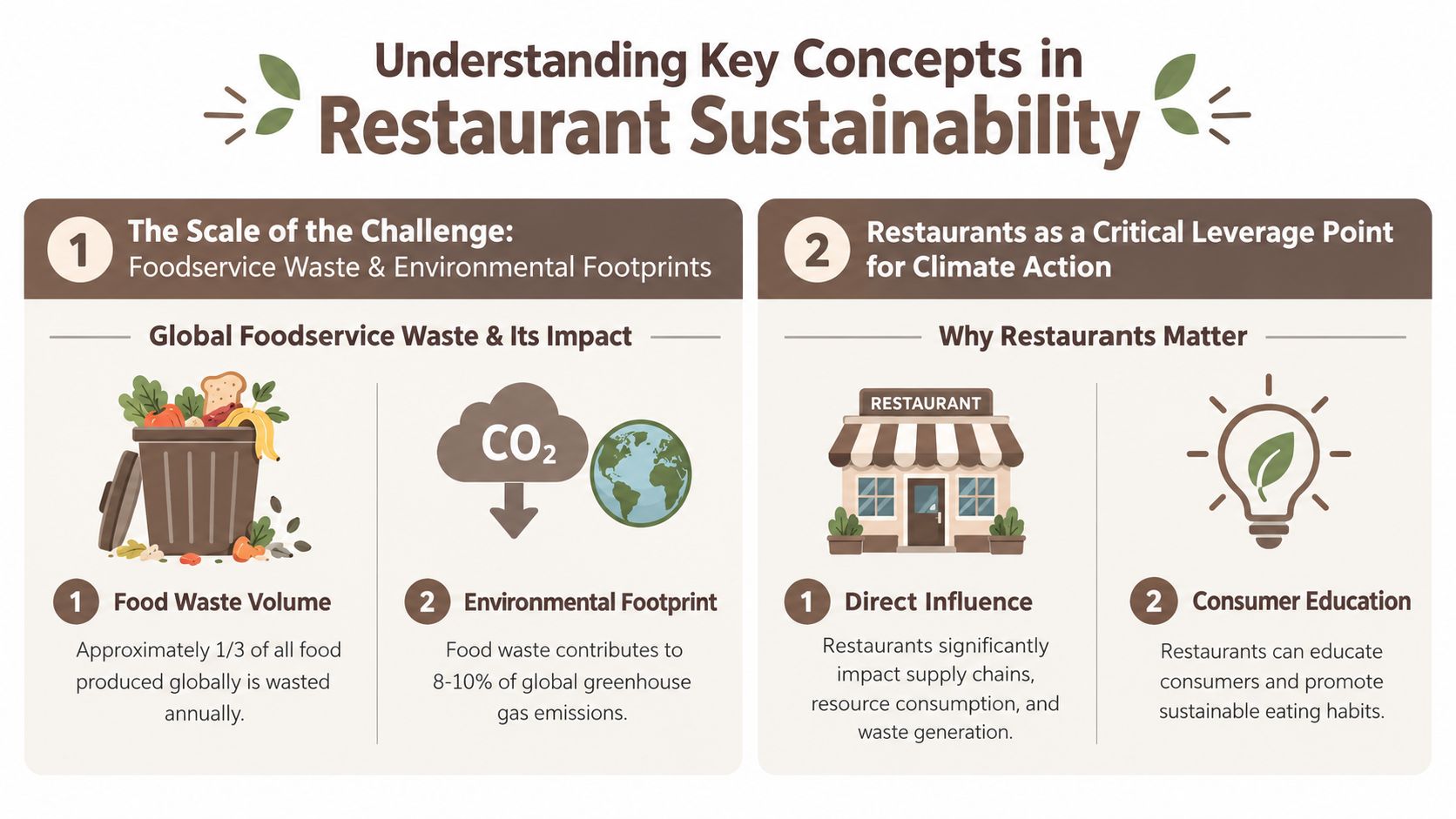
The leaky bucket view
A restaurant works like a bucket with four leaks. Procurement leaks when ordering is loose. Waste reduction leaks when prep waste, plate waste, or spoilage go unchecked. Material choice leaks when the operation uses formats that create more trash or more staff handling. Measurement leaks when nobody tracks what changed.
Practical rule: if you can't measure a loss, you can't manage it consistently.
That is why operators who focus only on packaging often miss the larger opportunity. Commercial kitchens sit inside a food waste, energy, water, and emissions nexus, so better refrigeration, shorter hot-hold times, and tighter batch cooking can improve more than one metric at once. The trade-offs matter too. A lower-cost item can create higher disposal, storage, or labor costs later, while a certified material may cost more upfront but reduce confusion around claims and handling. The result is simple, even if the mechanics are not. Fewer leaks mean less spend, less waste, and fewer surprises in the back of house.
Sustainable Sourcing and Procurement Practices
Good procurement starts with clear rules, not broad promises. If suppliers know you want local where practical, seasonal where possible, and certified products where the claim matters, they can quote against real requirements instead of marketing language. That makes buying easier for the chef, the purchaser, and the finance team.
A farmers' market is a useful comparison. You do not ask every vendor for the same thing, you compare what is available, check origin, and match the product to the menu. Restaurant procurement should work the same way, with a scorecard that weighs quality, consistency, delivery reliability, packaging, and the environmental certifications you trust.
A practical supplier audit
Start with what you already buy. Flag the items that create the most waste, the most freight complexity, or the most packaging. Then ask each supplier for three things, a clear product spec, proof for any sustainability claim, and the operational terms your team needs, including case size and delivery cadence.
A simple RFP can stay focused:
- Origin and seasonality: where the product comes from, and whether a seasonal alternative exists.
- Certification evidence: what certification supports the claim, if any.
- Packaging format: whether the item arrives in a way that reduces storage clutter or disposal volume.
- Service fit: whether the item works in your menu and prep flow without extra labor.
If a supplier cannot explain how the product fits your menu and receiving process, the product probably is not ready for your operation.
Group purchasing can help, but only if sustainability criteria stay intact. The goal is not to buy the cheapest item and call it green. It is to lock in the right spec at a stable price so the kitchen is not forced back into emergency purchasing later.
Cost analysis belongs in the same conversation. A lower unit price can hide higher costs in storage, handling, or disposal, while a certified material may cost more upfront but reduce confusion around claims and day-to-day use. That is why operators should compare the full path of each item, from purchasing to receiving to waste bin, rather than looking at the invoice alone.
For beverage service, the same discipline applies to accessories. If you are reviewing paper straw options, best paper straws is a useful reference point for matching format to drink type and service needs. In thicker drinks, a product like Smoothie Giant may be appropriate because the key consideration is whether the item fits the menu, the pour, and the guest experience.
The best procurement programs treat sustainability as an operating spec, not a slogan. They reduce waste, make receiving simpler, and keep hidden trade-offs visible before they show up as extra labor or disposal costs.
Strategies to Reduce Single Use Waste
Single-use waste starts with small decisions. One fork per order, one lid per drink, one condiment packet per guest, and the waste stream grows quickly across a service week. The fix is usually not one large purchase. It is a set of tighter choices that fit how the restaurant operates.
Start by asking whether the item needs to be single-use at all. In a café or fast-casual setting, the answer can change by daypart. Dine-in coffee can use a reusable ceramic mug, takeout may need a different format, and delivery often needs its own rules because transit and tampering risks are different.
Choose the right format for the service model
A practical decision path looks like this:
- High-traffic dine-in service: use reuse where guest turnover and washing capacity support it.
- Delivery and off-premise orders: keep the parts count low, then add only what protects food quality.
- Cold drinks and smoothies: test whether one-piece or lid-free formats reduce the number of SKUs on hand.
- Condiments and add-ons: move to bulk dispensers or request-only service when staff flow allows it.
That logic matters because waste prevention starts before the bin. In hospitality catering, 1 kg of food waste corresponds to about 3.4 kg CO2e and 61.1 L water (review), so a better process can reduce both trash and resource use. For operators, procurement and waste are the same conversation. The buying decision shapes storage, labor, and disposal later.
For teams weighing plastic bans against service quality, Nothing's plastic-ban guidance is a useful reference point because the replacement has to work in day-to-day operations, not only on a product page. The same review should include product fit. A cup like the Hot Cup needs to match the drink menu, handling routine, and guest flow before it earns a place in the lineup.
The best single-use reduction plan removes friction for staff, not just plastic from the purchasing sheet.
Cost analysis belongs in the same review. A lower unit price can hide extra storage, handling, or disposal work, while a certified material may cost more upfront but reduce confusion around claims and day-to-day use. That is why operators should compare the full path of each item, from buying to receiving to waste sorting, much like managing inventory for restaurant delivery keeps supply decisions tied to real demand.
One more useful check is component count. If a cup, lid, and sleeve can be simplified into fewer parts, back-of-house storage gets easier and ordering gets cleaner.
Compostable Alternatives and Certification Standards
Compostable claims sound simple until you compare them side by side. A cup that looks sustainable on a product page may still be hard to verify in real operations, especially if the claim does not match local collection or end-of-life conditions. Certification matters more than adjectives.
A recent review summary notes that many compostable claims are fragmented, and side-by-side certification data help operators avoid greenwashing and select products proven to break down under real-world conditions. That matters because the label alone does not tell you whether the item is accepted by your waste stream, your composter, or your local hauler.
Certification Standards Comparison
| Certification | Compostable Criteria | Certification Body |
|---|---|---|
| ASTM D6868 | Designed for compostable coatings on paper and fiber-based products | ASTM International, with third-party certification programs used in the market |
| EN 13432 | Requires compostability and disintegration under industrial composting conditions | European standards framework, with recognized certifiers |
| BPI | Verifies compostable products for composting environments in North America | Biodegradable Products Institute |
This table is a starting point, not the full decision. A water-based coating can reduce reliance on plastic linings, and PFAS-free construction can help operators avoid chemistry they do not want in the chain. Lidless designs can also simplify back-of-house because there is one fewer part to store, count, and order.
Operational fit is the most important test. Compostable coffee cups should be reviewed against your waste contractor, guest behavior, and cleaning flow, not just a material label. The same check applies to a format like Hot Cup, which is presented as plastic-free, PFAS-free, wax-free, and intended to break down in 180 days under real-world conditions.
Cost belongs in the same review. A certified item may cost more upfront, but it can reduce sorting confusion, staff questions, and the risk of buying a product that does not match your disposal path. A lower-cost alternative that fails collection rules is like buying kitchen equipment that cannot fit through the prep door. It looks cheaper until it creates a daily problem.
Use one simple rule: choose the material after you know where it goes after use. Compostable without collection is still a disposal problem.
Cost Benefit Analysis and Business Impact
A restaurant sustainability plan has to survive a spreadsheet. If the numbers don't make sense, the initiative gets cut the next time food costs rise or labor gets tight. That's why the financial side should include direct savings, avoided losses, and operational simplification, not just the purchase price of the new item.
The U.S. foodservice sector generates 12.5 million tons of surplus food worth $104 billion annually, and 78.4% of that waste went to landfill in 2024 (ReFED analysis summary). Those figures show why diversion and prevention aren't side projects, they're core cost controls.
How to model the return
Use four buckets in one worksheet:
- Procurement cost: compare the current item against the replacement item.
- Waste disposal cost: estimate what you stop sending to landfill.
- Labor time: calculate whether fewer parts, fewer errors, or simpler receiving saves staff time.
- Sales and brand impact: track whether the change affects guest satisfaction, repeat ordering, or marketing visibility.
For example, if a paper cup replacement lowers storage clutter and reduces lid handling, that can save time even if the unit price is higher. If a portion-control or forecasting change reduces spoilage, the savings can dwarf the cost of the software or training because you're cutting a loss before it becomes trash.
A useful outside reference for the competitive side of that equation is improving restaurant map pack visibility, since sustainability choices often show up in search, reviews, and guest perception long before they show up in a formal report. Operators should treat that visibility as part of the business case, not as an afterthought.
The most practical comparison is simple, which option reduces total cost per cover once you include waste, labor, and disposal? A lower sticker price doesn't matter if the product causes more breakage, more reorders, or more cleanup.
Roadmap to Implement Sustainable Practices
Sustainability sticks when someone owns the work and the timeline is realistic. A kitchen can't fix procurement, disposables, and data reporting in one week, so the better move is to phase the change and protect service quality while the new habits settle in.
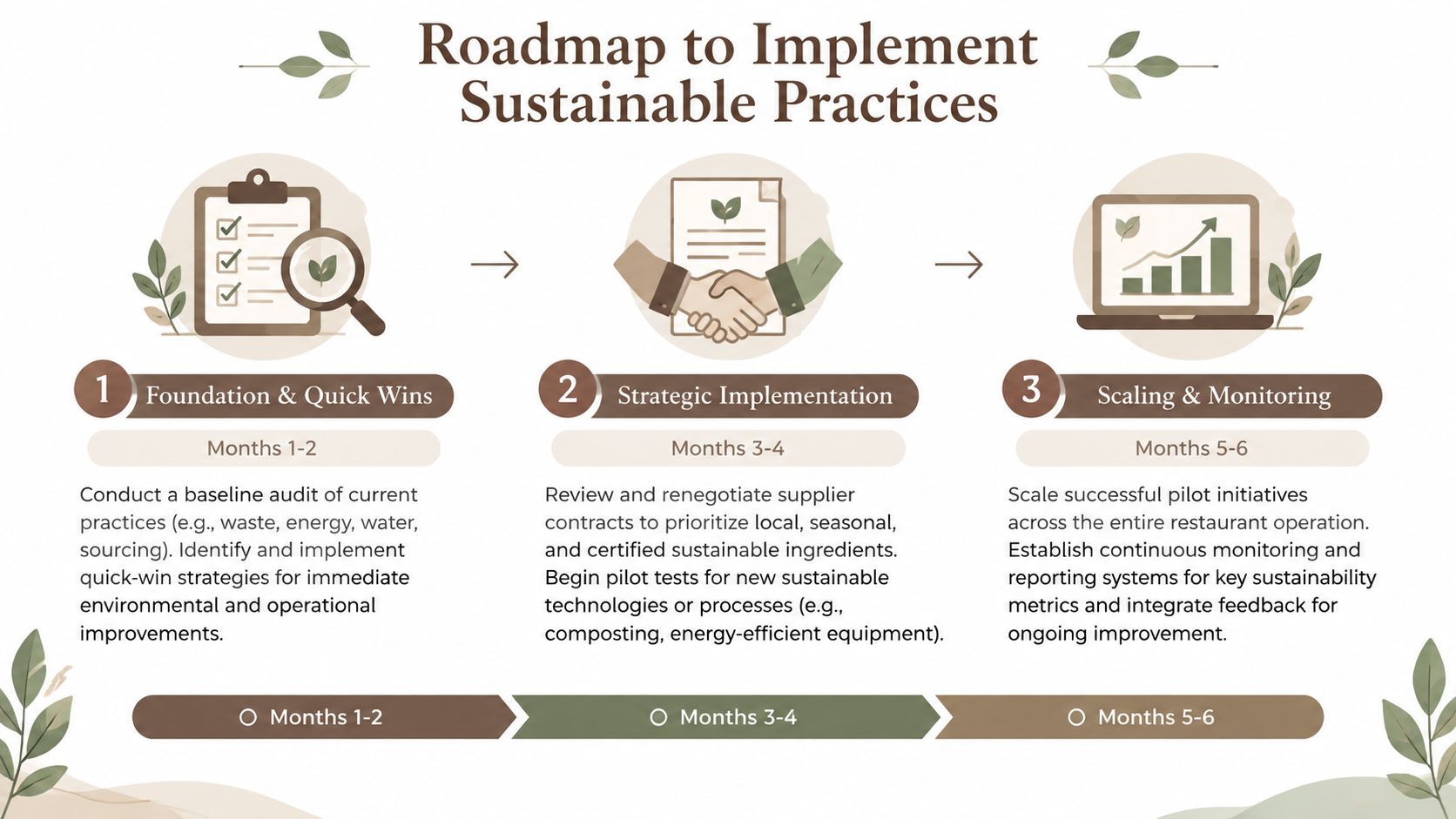
A six-month rollout
Months 1 to 2, foundation and quick wins. Assign one owner, run a baseline audit, and fix obvious losses first, like overordering, unnecessary disposables, and poor storage rotation. That gives the team early momentum without waiting for a full tech rollout.
Months 3 to 4, strategic implementation. Tighten supplier contracts, pilot new material specs, and test operational changes before scaling. This is the stage where governance matters most, because measurement, ownership, and circularity were all weaker than basic tactics in a recent global foodservice outlook (EHL outlook).
Months 5 to 6, scaling and monitoring. Roll out what worked, train the team, and tie the results to a simple dashboard. A restaurant that tracks waste, procurement, and service changes together can spot problems before they become expensive.
A practical operating rule helps here, too. If a change needs constant heroics from staff, it won't scale. The right process feels boring after the first few weeks, because it becomes part of how the kitchen runs.
Conclusion and Next Steps
Sustainability in restaurants works best when it's treated like operations, not branding. The strongest programs cut waste, simplify procurement, improve material choice, and make the financial trade-offs visible to the people who order, prep, and manage the business. That's how environmental progress and margin protection line up instead of competing.
Start small and make it measurable. Pick one menu category, one disposable format, or one supplier group, then track what changes over a month of service. If the pilot lowers waste or reduces back-of-house complexity, expand it. If it creates friction, adjust the spec before you roll it out further.
A short checklist helps:
- Audit one waste stream and write down where the loss starts.
- Review one supplier category and ask for clearer product specs.
- Test one compostable or reuse option against actual service conditions.
- Assign one owner who can report progress to the team.
Nothing offers compostable cups and straws built around practical foodservice use, with clear product specs that help operators compare formats without relying on vague claims. If you're ready to tighten your sourcing, reduce single-use waste, and make your sustainability plan easier to run, visit Nothing and review the options against your own menu and workflow.
